Sunday, November 11, 2012

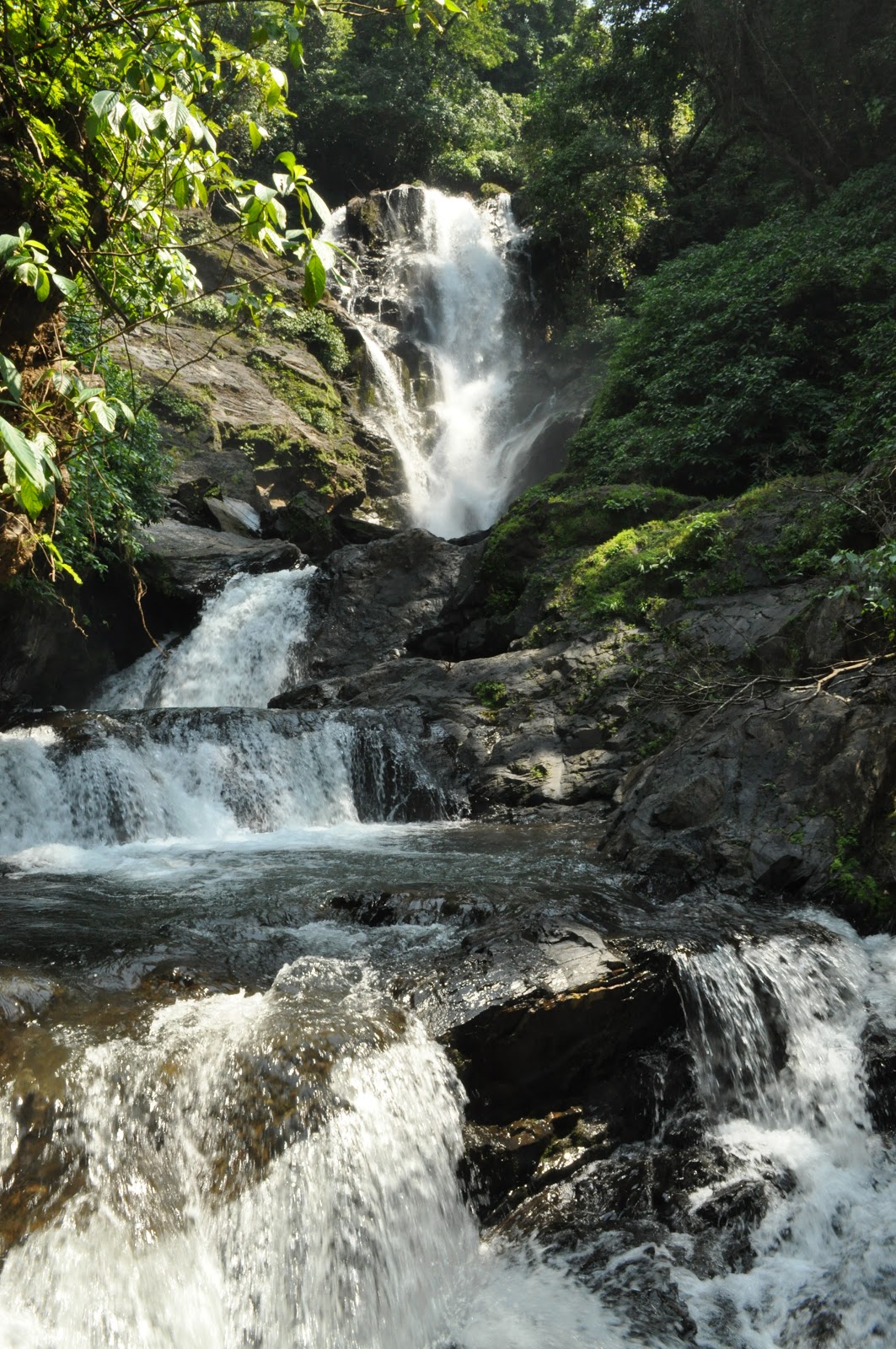
Viboothi Falls, Sirsi

When we first planned to visit Sirsi, the idea was to go waterfalls-hopping. Sirsi and its surroundings have so many waterfalls that we were skeptical of being able to cover them all. But ironic as it may seem, after one and a half day of travelling, we had so far seen just one waterfall. Days prior to the trip when we were reading up on Sirsi, we stumbled upon places much more interesting than just waterfalls and so it came to be that we were going to the second and last waterfalls of our trip.

Viboothi Falls is a mere 8kms from Yana, but the winding and treacherous road makes it look longer than that. From the end of the motorable road it’s another 2 km walk to the waterfalls. Viboothi is as pristine as they come these days. Nestled in the Sahyadri Ranges and formed on River Gangavali, Viboothi gets its name from the limestone formations in the area. It is a 3-tier waterfall that forms a tiny pool, worthy of being called heavenly. The riverbed in this pool is haphazardly stuffed with big boulders, making it very perilous for the tourists. You have to be extremely stupid to dive into these waters. Unlike Sathodi, this is the kind of falls where you can relax, unwind, take a dip and refresh yourself in the pristine waters. It is an ideal picnic spot where you can spend a couple of hours playing in the waters and not know the time fly-by. Though Sirsi has many waterfalls, not all of them entertain the tourists to play in their laps. Viboothi is one such falls that embraces her visitors and leaves them wet, fresh and recharged. A must-visit waterfalls for your Sirsi itinerary.

Getting-there: 8kms from Yana.

Must-Do: Take a dip in the water and get totally refreshed and rejuvenated.
Must-Don’t: Diving into the pool and littering the place.

My Rating: 8/10

Sunday, November 04, 2012

Yana, Sirsi

Bhairaveshwar Shikara
It pays to have good friends, more so when these people are random guys you met in blogosphere. So, on Day1 of our Sirsi trip when we had given up hope on finding a room (all rooms in all hotels occupied, thanks to Dassera) in Sirsi, this blogger friend of a fellow traveler turns out to be our knight-in-shining-armor. All it took was one phone call and within minutes the six of us were given two of the best rooms in a hotel which belonged to a relative of our blogger friend. As if that magnanimity wasn’t enough, the hotel refused to take a single penny from us for our one-night-stay! A hot water bath and a good night’s sleep ensured all of us were all charged-up for the next day. A sumptuous breakfast later we were headed towards Yana.

Bhairaveshwar Shikara with Shiva temple
Yana is famous for two massive rock formations. Essentially, these rock formations are black crystalline limestone. The entire village of Yana is known for these rock formations. But there are 2 such formations that are of mythological significance, namely, Bhairaveshwar Shikara and Mohini Shikara. Yana is as much a geologist’s delight as it is for a pilgrim. The Bhairaveshwar Shikara is popular for a Swayambhu (self-manifested) linga. Add to that water drips on to this linga from the rocks thereby making the alliteration that it is holy Ganga flowing. However, the scientific reason for the formation of the swayambhu is attributed to phenomenon of stalactites and stalagmites.

Most of the pictures you find of the two shikaras on internet do no justice compared to the real deal. These are massive rock formations, standing as tall as 120 metres (Bhairaveshwar Shikara) and 90 metres (Mohini Shikara). These rocks are not without its share of mythological stories and prominence, as the names suggest. As per the mythological stories, the demon king Asura through persistent penance obtained a boon from Lord Shiva whereby on whomsoever’s head Asura places his hand, would turn to ashes (hence the name Bhasmasura). But Asura turns a Frankenstein’s monster and wants to test his strength on Lord Shiva Himself. After being chased by Asura, Shiva seeks refuge and advice from Lord Vishnu. Vishnu takes the form of damsel Mohini and entices Bhasmasura with her beauty and dance. An infatuated Bhasmasura agrees to a dance competition between the two. In one of the mudras (dance pose) Mohini places her hand on her head which an unsuspecting (and blindly in love) Asura copies, only to be turned into ashes by his own foolishness. The resulting combustion was believed to be so intense that it blackened the limestone formations of entire Yana. The Bhairaveshwar Shikara (Shiva’s Hill) and Mohini Shikara (Mohini’s Hill) thus got their respective names and temples (Mohini Shikara houses a Parvathi temple).
Mohini Shikara
Just like in Banavasi, the priest of the Shiva temple here gives all the devotees a briefing on the mythology of this temple. The pradikshina of the temple here is probably the longest and toughest of them all as it involves walking around and between these rock formations on barefoot. Once you are done with Bhairaveshwar Shikara, there are steps downhill that takes you to Mohini Shikara and the Parvathi temple.
This area once used to be a dense Sahayadri forest. And it took a trek of nearly 17kms from civilization to just reach these rocks. But crass commercialization and road-laying has done away with all this. And now visitors need to walk just half a kilometer from where they can park their vehicles. The day is not far behind where you can drive right up to the base of these hills. There’s a popular saying in these parts of the world - Sokkidhavanu Yanakke hogutaane, rokkiddhavanu Gokarna ke hoguthane, meaning, the one with tremendous guts and determination goes to Yana and the one with money bags goes to Gokarna. Unfortunately that is no longer true in these times of rapid and unbridled development.

Getting-there: Around 40kms from Sirsi town.

Must-Do: Check out the rock formations and the Swayambhu.
Must-Don’t: Littering and Vandalism. 

My Rating: 8/10

Information Courtesy: Wikipedia, OurKarnataka

Tuesday, October 30, 2012

Sathodi Falls, Yellapur

This was my second attempt at getting to Sathodi Falls and yet again for a briefest of moments I felt my chances of getting to see this waterfall receding, just like the sun setting in the horizon. The first attempt was a failure because accessibility was an issue. After reaching Yellapur, I found that there were no buses that go to Sathodi Falls. I knew it wasn’t wise to hire a Jeep or a rickshaw as they would charge me buckets. I was told that youngsters there offered to take you to Sathodi for a nominal amount. As it turned out, the nominal amount was Rs. 400 – something that I was expecting the Rickshaw-wallas to demand. I decided to drop the plan and instead go to Magod Falls. But even that didn’t materialize since the bus timings were very erratic and less frequent.

But this time round I was travelling with a group and with our own transport – a Tavera. The threat to our chances was however from the receding daylight. Our first challenge was to enter the forest area before 6:30PM before the gates close. And the second was to spend enough time enjoying the view and yet get back to civilization before it’s too dark. Sathodi is a 28km drive through the forests from Yellapur town. The roads are in a bad shape for the first 23kms. For the last 5 kms there is simply no road. Ok.. Im exaggerating a bit here. There is indeed a mud road for the last 5 kms but it’s in a pathetic condition. The rains make the road even worse with loose soil and slippery slopes.

With the menacing road taking a toll on the vehicle and the eager-to-retire sun looming over our heads, we started questioning the rationale of going ahead with our plan. Would the destination be worth the journey? Would we be able to spend at least 10 minutes there? Even if we do, are those 10 minutes worth the trouble we took just getting here? What if we have a flat tyre on the way back? Is it safe to spend the night in this jungle? Just as all these questions were hovering around inside the confines of our heads, we got our first glimpse of the backwaters of Kodasalli Dam. And just like that, our apprehensions started disappearing. We were now more than eager to get to the waterfalls.

We finally reached the check-in point of the falls where we paid a nominal entrance fee and quickly made our way to the falls. A one kilometer walk later we gaped with open mouths at India’s little Niagara falls. I had to admit that the pictures you see of Sathodi in the internet do no justice to the real deal. Even though you don’t get to go near the foot of the falls, the view is pretty intimidating. While most waterfalls I’ve seen till date are tall, and single or multi-tiered, this one was w-i-d-e. And thanks to all that rain for the last couple of weeks, Sathodi was a decked-up princess. Anybody with half a brain would know better than to venture into the water. At this time of the year Sathodi was strictly a viewing-only waterfall. Even though we had set ourselves a deadline of 15 minutes to reach back to our vehicle, half an hour had already passed. Not completely content with the amount of time we spent here, we had to drag ourselves back to the car. Our apprehensions of a flat tyre were highly misplaced and we reached Yellapur, and subsequently Sirsi, incident-free.

Getting-there: Sirsi->Yellapur ->Sathodi (Follow the signboards at Yellapur)

Must-Do: Start early so as to spend enough time there and get back safely
Must-Don’t: Adventurism or heroism in the rapid waters.

My Rating: 8/10

Sahasralinga, Sirsi

The literal translation of Sahasralinga means a 1000 Lingas. And that’s precisely what you get to see here. On the banks of river Shalmala are carved hundreds and hundreds of Shivalingas and Nandis (Basavannas). It is believed that for every Linga, there is a Nandi staring at it. Currently there are far too fewer lingas, and even the ones present have suffered some damage over the years thanks to the force of the ravenous waters. Even then the sheer number of Lingas and Nandis is sight to be seen to be believed, notwithstanding the fact that we went there at a time when the water flow was high.

These Shiva lingas were built by King Sadashivaraya of Sirsi. It is best to visit Sahasralinga during the dry seasons, when the flow of water is pretty less. Sahasralinga is 10 kms from Sirsi. A recent addition to this tourist location is a hanging bridge built across the river to connect neighboring villages. Since the flow of water is comparatively gentler, this place can also double up as a picnic center. Children might enjoy play in the water here.

Getting-there: About 10 kms from Sirsi en route Yellapur.

Must-Do: Visit during the dry seasons to see more of the lingas surfacing.
Must-Don’t: Vandalism and Littering.

My Rating: 6/10

Monday, October 29, 2012

Madhukeshwara Temple, Banavasi, Sirsi

Long before colonial Bangalore was deemed the capital of Karnataka, there was a lesser known capital for the state, which goes by the name of Banavasi. Set up in the 9th Century AD by the Kadamba dynasty, Banavasi was known to be the earliest known capital of Karnataka. As with most dynasties of that era, the kingdom revolves around the main temple in area. Madhukeshwara Temple occupies that significant stature in this regard. So prominent was Banvasi and the Madhukeshava temple that the temple originally built by Kadambas were renovated/extended by Chalukyas and the Hoysalas. As a result one can easily notice the different architectural styles starting from the garba griha to the mantapas. And yet there is no denying the fact that the mastery of the Hoysala craftsmen shine through. Hoysala craftsmen are top-of-the-class pioneers in stone craftsmanship. And their style is so distinct and uniform you can identify it pretty easily. The famous Hoysala artisan Jakkanacharya is being credited for the Hoysala additions. Im really beginning to doubt the existence of this character called Jakkanacharya. He’s been being associated with every Hoysala Temple dotted across the state. So unless he’s a superhuman sent from outer space, it’s highly unlikely that he would have worked with each of these temples

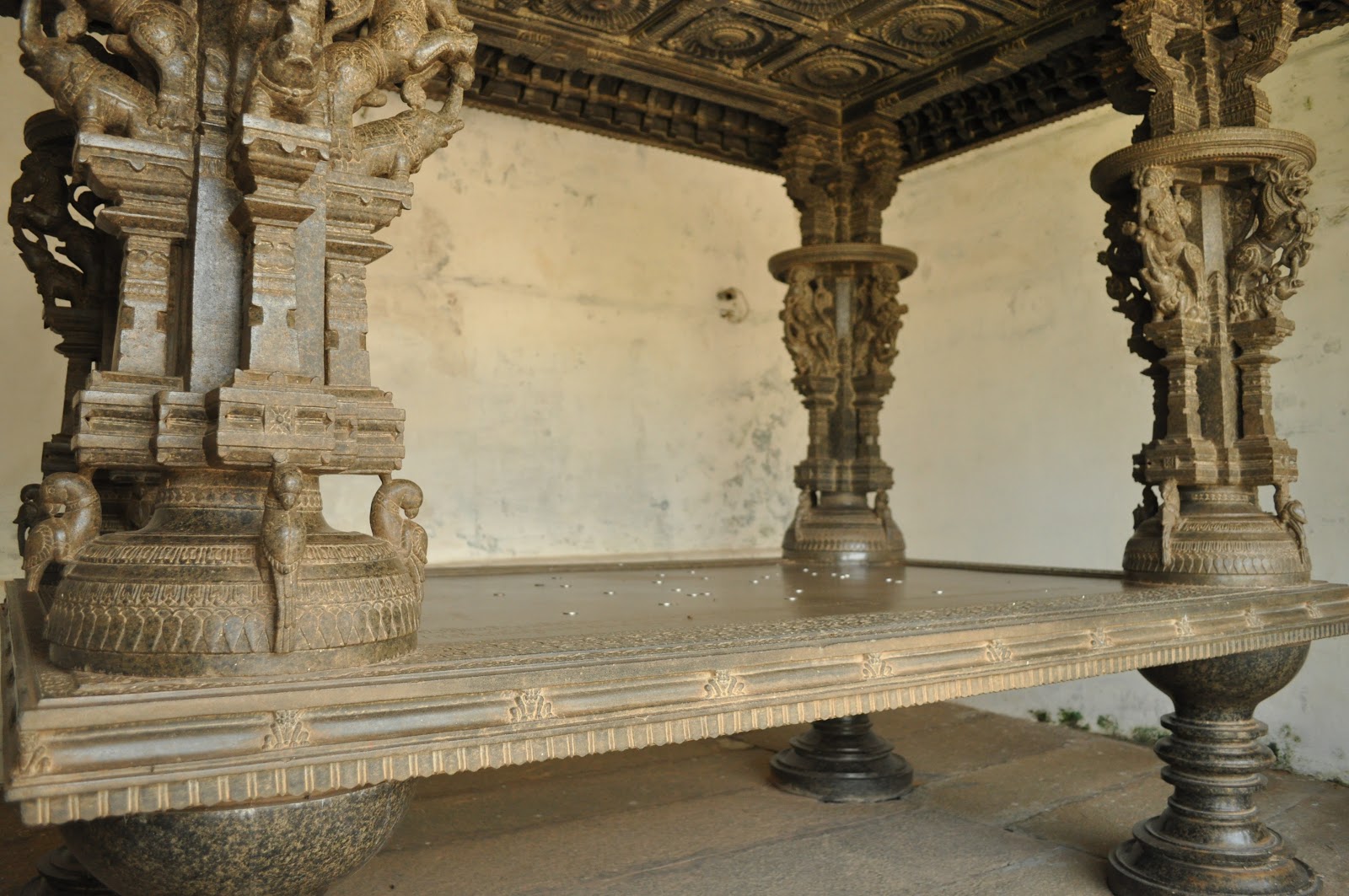
Onte Kallu Mantapa

Banavasi is a true-blooded Kannadiga pride temple town. Not only was it considered the first capital of Karnataka, it was also the birthplace for Kannada’s first poet, Adikavi Pampa. Few coins discovered here a few years ago, date back to the 5th Century with Kannada inscriptions on it. This means that the existence of a mint factory here can be considered amongst the oldest in the country.
When we arrived here, we found out, much to our dismay that there were no ASI guides who could give us a sneak peek into the history of this magnificent temple. But just as we were loitering around clicking pictures, a priest herded us together and starting giving us a guided tour of the temple. Even though we knew pretty well that there was no such thing as a free meal, we didn’t mind paying the priest for an insight about the temple.  The priest began by giving a brief history of the temple built by the Kadambas and subsequently renovated and improved upon by the Chalukyas and Hoysalas. He told us the reason behind the Shivalinga being called Madhukeshava. The large linga here is in the color of honey (madhu) contrary to the black that we see elsewhere. He also talked about the specialty of the large bell outside the garba griha. This bell made from pancha loha (5 metals) is unique because the gong of the bell rings for close to a minute. He then showed us the Triloka Mantapa carved out of a single stone. It is undoubtedly the work of the Hoysala craftsmen. It goes without saying that such artwork can only be produced from the Hoysala breed of artisans. This is followed by the trademark Hoysala pillars, that’s a common garnish in every Hoysala Temple. The concave and convex reflective pillars not only accentuated the viewing experience of the performing dance artists but also speaks volumes of the mastery of these stone artists.
Can you spot the right eye of Nandi?
The Onte kallu Mantapa (single stone mantapa) is yet another classic from the Hoysala staple – again, carved from a single stone. The other notable and no less artistic brilliance is the Nandi statue. The first thing most of us might straight-away notice is that the Nandi is not directly looking at Shiva but is rather looking slightly to the right. The reason behind this is that while Nandi’s left eye is looking directly at the Shivalinga, its right eye is looking at Parvathi which is separate temple adjacent to Shiva’s. Such is the mastery of the stone artisans of that era that despite a maze of pillars, the right eye of Nandi is transfixed on Parvathi Devi. Unbelievable? Well, you can confirm it yourself by standing in front of the Parvathi temple and looking at Nandi. Another important attraction here is the Ardha Ganesh. This statue of Lord Ganesh is split vertically right at the middle. It is believed that the other half is in Kashi.
These are only some of the stand-out features of this temple. By the end of it all we were left dizzy with amazement. With the Sun beating down hard we decided to spend a little more time admiring the place. After all it’s not every day you get to be a part of history. All that textbook knowledge of our History lessons look so worthless compared to the couple of hours we spent here.
Now did I say there’s-no-such-thing-as-a-free-meal a while ago. Ok, I take that back, because there was a free anna daanam in the temple served at exactly 1PM. We devoured the hot rice, blistering sambar and the super cool majige like there’s no tomorrow. With a content stomach and heart we started for the next leg of our Sirsi trip – Sahasralinga.
 
Getting-there: Approx 30 kms from Marikamba Temple.
Must-Do: Ask the priest for a guided tour. Free Anna Daanam at 1PM.
Must-Don't: Vandalism and Littering
My Rating: 8/10