Showing posts with label Karnataka. Show all posts

Monday, January 28, 2013

Kukke Subramanya Temple, Subramanya


The Kukke Subramanya Temple in Subramanya village of Dakshina Kannada is a temple of ironies. Devotees from across the country come here to get rid of their Sarpa Dosa (Serpeant Curse). And yet this temple can into existence because Vasuki, the King of Snakes, wanted to protect his ilk from the wrath of Garuda. Vasuki earnestly prayed to Lord Shiva who sent Subramanya to Vasuki as a reward for his penance. Subramanya has ever since been worshipped as the protector of snakes. And that’s not the only irony. The temple houses a silver Garuda tower which is believed to be erected to protect devotees from the poisonous fumes of Vasuki’s breath. Another interesting tidbit about this temple is that devotees enter the courtyard from the back and go round to east-facing entrance.

Interesting tidbits and anecdotes and mythology aside, the Kukke Subramanya temple is a must-visit in the pilgrimage circuit of Karnataka and South India. The majestic Kumara Parvatha in the background, the pristine Kumara Dhara river flowing by the temple and quaint little temple town nestled in the Western Ghats is worth a visit. Subramanya is easily accessible from Bangalore, Mangalore and Hassan. Trekking enthusiasts and devotees arrive here in large numbers. Whether it’s trekking in nature’s lap in the most grueling way or getting rid of Sarpa Dosas from this life or the previous or just getting away from the monotonous city life to a relaxing weekend filled with devotion and nature’s abundant beauty, Kukke Subramanya is one of the ideal locations to fulfill your need.
Getting-there: Overnight buses are available from Bangalore to Subramanya town. There is also a railway station at Subramanya.
Must-Do: Take a dip in Kumara Dhara before entering the temple.
Must-Don't: Littering.
My Rating: 6/10

Saturday, January 26, 2013

Kumara Parvatha Trek - Take 2

The last time I attempted to summit Kumara Parvatha and failed by a small margin, I swore to myself that I will never come back to this wretched place. In my previous attempt I got drenched in equal measures from the sweat and the rain. Every bone, muscle and tissue in my body hurt from the 14-km inclined trek. On the one hand where every item in my backpack felt like an extra burden apart from my own modest body weight, in the other, I was losing weight thanks to the depleting water levels in my body owing to dehydration and loss of blood to the leaches. But more than a year later, here I was standing in front of Kukke Subramanya temple with my backpack and staring at Sesha Parvatha in the background. Such is the lure of KP.

As daunting as it was, I was supremely confident of completing an unfinished task with KP. The ease and technique with which I conquered Chembra Peak a month ago had made me to believe that KP will fall. And fall it did, but not before all the travails of a hard trek. Thankfully the blood-sucking leaches were no longer in play, which also meant the Sun was out in full glory. And that really took a toll on us once we crossed the forest cover. This time on the way up we gave Bhattare Mane a miss since we had made it to forest office in good time. Having reached Bhattare Mane before lunch, we gave it a miss and instead camped at the forest office devour the lunch we had packed from home. A good lunch and short relaxing break later we headed to the near 90 degree climb. The Sun being merciless, we had to take multiple breaks to avoid dehydration and a possible sunstroke. But with hardly any trees in sight to provide shade, the brief stops were meaningless.
After we somehow dragged ourselves to the watering hole near the Mantapa, we rested there for half an hour. Some of us even managed a few winks. The final stretch to Sesha Parvatha is where you start questioning yourself if you have gone completely crazy to be doing something like this. As tired as we were, we still managed to pull ourselves atop SP by around 6PM. The progress we made from Bhattare Mane to SP has been slow. But considering the terrain and the Sun, it was a task well done. With light fading away soon, we did not stop to admire the view at SP, instead headed to the forest cover immediately after that to the place we could set up our tents and start a fire. All of us worked in tandem – while some of them put up the tent, some went to fetch water from the stream and the others went looking for firewood. In about an hour we were all set to settle down for the night. Out came all the MTR ready-to-eats and we devoured them all in no time. With an aching body and a full stomach we sat around the fire for a while chatting until we finally retired into the comfort of our tents to call it a day.
Next morning we woke up early but got up somewhat late – if you know what I mean. And right away we headed for KP. The view offered by KP is a tad disappointment. Add to that, the peak is very crowded with a lot of overnight campers. The place chosen by us was just right. We spent about an hour at the peak before we decided to head back to the tents in the forest area. Wrapping up our tents, we started on our way back. This time however, we spent time at SP doing what we do best – monkeying around and capturing them in pixels. The descent proved to be slower than expected with our tired bodies not cooperating with our heads. Finally at noon we were at Bhattare Mane - just in time for lunch. By now I was so hungry, I could eat an elephant. Well I did not eat an elephant but I ate rice portions that probably an elephant would eat. Never in my life have I eaten so much rice at one go. The steaming hot rice, sambar, pickle and majige is like manna from heaven. A good rest and some coffee later we started towards Kukke Subramanya, thanking Bhatta for his hospitality and his quirky small talk. A couple more hours later we were on ground zero, tired and exhausted. A cold water dip under fading lights in the Kumaradhara river brought back much of the life in us.

As always KP has been a bone-crunching and energy-sapping trek and puts your mind power rather than muscle power to test and this time we emerged victorious.

Getting-there: The trek starts from Kukke Subramanyam Temple.

Must-Do: Do this trek between October to December. Watch the sunset and sunrise if you are lucky.
Must-Don't: Littering

My Rating: 8/10

Wednesday, January 16, 2013

Cheluvanarayana Temple, Melukote

Melukote has been on my travel bucket for long. But as luck would have it, while I finally made it to Melukote, it wasn’t a totally fruitful trip. This was the longest road trip for our 11-month old and as it turns out – the most difficult. It was extremely difficult to keep leash on our hyper-active and restless little angel. She can be quite a handful in such occasions and that takes a toll on her mother too who was all but drained-out by the time we reached Melukote. My mother-in-law is another person who can’t undertake long road trips even if the end result is visiting a famous temple. As a result when we reached Melukote, we visited the Cheluvanarayana Swamy Temple and returned back to Bangalore. The idea of climbing some 200-odd flight of stairs uphill to visit the Yoga Narasimha Temple did not find appealing enough for my wife and mother-in-law after such a long journey.

The Cheluvanarayana Swamy Temple is built on the foothills of Yadugiri and is situated about 145 kms from Bangalore and about 50 kms from Mysore. The temple is dedicated to Thirunarayana or Cheluva Narayana. On the top of the hill there is a temple for Yoga Narasimha. There is also a beautiful stepped tank at the base of the hill. It believed that the famous Srivaishnava Saint Ramanujacharya resided here for about 12 years in the 12th Century, thus making it a prominent place for Srivaishnava Sect and also home to the Academy of Sanskrit Research.

The exact year of construction of the temple is not known. But it is believed to have existed even before Ramanujacharya retrieved the lost metallic image of the presiding deity. It is also believed that Ramanujacharya using his influence and stature was instrumental in rebuilding and renovating the temple. Hoysala King Vishnuvardhana who was a follower of Ramanujacharya had taken refuge here for a brief period during the Muslim invasion of Dwarasamudra. Glimpses of Hoysala art are also very evident here. But it is not nearly as magnificent as any of the full-fledged Hoysala temples in the area.

For those who enjoy long drives, this is a good place to drive down to. The final stretch of 32 kms after exiting the Bangalore-Mysore road is also pretty good for most part. There are some winding stretches of well-carpeted roads when you can glide at 100 kmph. The village atmosphere, green paddy fields and the fresh air make the drive even more pleasurable.

Getting-there: Take right after Mandya town and follow the road for some 30-odd kilometers.

Must-Do: Visit both temples (Cheluvanarayana and Yoga Narasimha) and the Stepped Tanks
Must-Don't: Littering and Vandalism.

My Rating: 5/10

Wednesday, November 14, 2012

Boga Nandeeshwara Temple, Bangalore

Strange are the ways of the world. There are some things that I just don’t comprehend. That every Bangalorean has been to or knows about Nandi Hills is a common knowledge. But ask them about Boga Nandeeshwara Temple and they will draw a blank. What’s the connection? Well, the Boga Nandeeshwara temple is situated right under the nose of Nandi Hills. What makes the matter even more intriguing is that this is no ordinary run-of-the-mill temple. This temple was originally built in the 9th Century by Bana Queen Ratnavali. This temple was then expanded and renovated by the dynasties of Gangas, Cholas, Hoysalas, Pallavas and finally the Vijayanagaras. This is also quite easily one of the largest temples in and around Bangalore. Despite all this, the Boga Nandeeshwara temple is off the tourist map for reasons unknown. Also the Karnataka tourism boards that usually display even the slightest place of tourism interest have conspicuously missed out on Boga Nandeeshwara temple. That could be one reason why so few people know about (and visit) this temple – which is good in way because this temple so far has been well maintained with sprawling lawns, well-kept structures and even clean bathrooms!

The Boga Nandeeshwara Temple houses three different temples namely, the Arunachaleshwara, Uma Maheshwara and finally the Boga Nandeeshwara temples. They all together represent three stages of Lord Shiva’s life – Arunachaleshwara depicts Shiva’s youthful life, Uma Maheshwara depicts Shiva’s wedding with Parvathi and Yoga Narashimha depicts Shiva’s renunciation stage.

To the trained eye it is easy to make out the architectural styles of Gangas, Hoysalas and the Vijayanagaras. The many stone pillars in the temple reminds its devotees of the temples of Hampi – rich in stone artwork. The also houses a Mahanavami Dibba and a stepped tank called Shringi Theertha a lot like the ones we saw in Hampi. The temple also has a few soapstone sculptures which leaves a Hoysala signature in the temple. The highlight of the temple, in my opinion, is however the Shringi  Theertha (a stepped tank). This pond is believed to be created by Nandi by plunging its horns into the earth to draw water from holy Ganga. We spent at least an hour in the serenity and peacefulness offered by this magical place (but for the annoying “caretaker” who came asking for money every 10 minutes for no reason, which we obviously didn’t oblige).
In the end it was hard to bid goodbye to this temple but then we knew we would come back soon enough.

Getting-there: Cross Devanahalli airport and the take the left which goes to Nandi Hills. This road ends in a T-junction where left goes to Nandi Hills. Take the right here and travel 5 kms.

Must-Do: Check out the Stepped Tank and the stone carvings around the temple.
Must-Don’t: Vandalism and Littering.

My Rating: 8/10

Banashankari Temple, Badami

The Banashankari Temple at Badami is a somewhat lesser known entity compared to its massively popular next-door neighbour - the rock-cut cave temples of Badami, so much so that I’m writing about this temple after almost 3 years of visiting the place. The inspiration came after a couple of friends recently went to this temple on their Hampi- Badami-Pattadackal circuit tour. Thanks to their trip, I start digging into the pages of history for gathering more info on the temple. It’s not for nothing people say that every travel is an education in itself.

Those were the days when my better half worked in Hubli and I in Bangalore. So on one of my visits to Hubli we decided to cover the Badami-Pattadackal-Aihole circuit. As it turned out, we cut short our trip after visiting Banashankari Temple and Badami Cave Temples. That morning we started off from Hubli in a rickety government-owned bus and reached our destination close to noon. After alighting from the bus we enquired about Badami cave temples with a rickshaw guy in our broken Kannada interspersed with Hindi. Whether it was a total communication failure or taking-us-for-a-ride thingy, we were dropped off in front of Banashankari Temple.

This 7th Century AD temple complex instantly catches your attention with its high walls, watch-cum-lamp tower and large temple pond with stone mantapas on three sides. Not one to waste an opportunity of looking at the architectural wonders of our forefathers we entered the temple and offered prayers to Banashankari (a.k.a Vanashankari) Devi. Banashankari is believed to be another form of Lord Shiva's consort Parvathi. This temple was originally built in 7th Century by the Kalyani Chalukya Kings and later renovated in the 17th Century by a Maratha Chieftain Parasuram Agale. Hence, even though the original temple has glimpses of Dravidian style, the later additions are the distinct style of the Vijayanagara era.

According to the scriptures, people of this area were harassed by the demon Durgamasura. Answering the fervent prayers of the inhabitants, Shakambari Devi was sent to protect the people. Not surprisingly the demon was killed in a fierce battle and peace restored in the area. The forests around the temple provided enough food for the people here in times of a famine. Hence the Goddess got the name Shakambari. It is definitely worth visiting this temple which is rich in history and mythology.

 
Getting-there: From Hubli take the Gulbarga-Bijapur highway and take right at Kulgeri.

Must-Do: Check out the age-old lamp tower and temple pond.
Must-Don’t: Vandalism and littering.
 
My Rating: 6/10

Mahabaleshwar Temple, Gokarna


The Mahabaleshwar Temple in Gokarna is believed to be one most significant temples in South India from a mythological perspective. The presence of an Atma Linga here makes it one of the holiest and highly revered temple. Legend has it that Ravana’s mother who is a staunch devotee of Shiva was performing a penance for her son when Indra jealous of her devotion, disrupted her penance by throwing the linga into the sea. A distraught Ravanna, performs a severe penance in Mount Kailash to please Lord Shiva. Impressed by his devotion Shiva bestows a boon to Ravana. Ravana asks Shiva for the Atmalinga. Shiva then gifts Ravana the atma linga with instructions that it should not be placed on the ground. Perturbed by the powers bestowed on Ravana, Shiva’s sons approach Vishnu to redeem the situation.

While Ravana is heading back to Lanka, Ganesha intercepts him taking the form of a little boy. Ravana asks the little boy to hold the idol (and not place it on the ground) while he would be back after offering evening prayers. But when Ravana does not return in the stipulated time, Ganesha places the idol on the ground and leaves. Once placed on the ground, Ravana tries with all his might to lift the linga but it stays put, thereby forcing Ravana to return to Lanka empty-handed. It is this atma linga in the temple that draws devotees in the thousands.

Our original plan after visiting Viboothi Falls, was to go to Unchalli Falls and if time permits Kumta Beach. But some mystical power forced us to re-draw our plans to end the Sirsi trip with a visit to the Mahabaleshwar Temple in Gokarna and a beach trek from Gokarna to Kudle. As soon as we entered the temple we were confronted by a battery of poojaries. They cornered us like salesmen and started rattling out a list of poojas that they can perform for you. And the a la carte included poojas of varied denominations starting from as high as Rs.500 to as paltry as a sum of Rs.50. And that frankly was a big turn-off. Thankfully we got a quick darshan and we were out in no time. The best part however was that you get to touch the Atma Linga in the sanctum sanctorum of the temple.
After the tryst with the atma linga we walked to Gokarna beach and without spending another minute(going by past experiences) started walking towards kudle beach. Kudle has been one of my favorite beaches ever since I went there almost 3 years ago. But going there after all those good memories I was a little apprehensive. In the last 3 years, surely Kudle must have been commercially sold out. There sure is going to couple of resorts, some tens of night clubs an hundred little shacks. I dreaded the thought of watching such a sight. Thankfully I was not entirely proved right. But Kudle is slowly and surely going that route. Another couple of years and Kudle would have gone the Goa-way. Sigh! After another wonderful Sunset (a Kudle speciality), we headed back to Gokarna. A laugh-riot dinner later we started to head back to… Damn I don’t even want to mention that name… L

Getting there: In the heart of Gokarna town. The temple is right on the beach.

Must-Do: Touch the atma linga.
Must-Don’t: Waste time at Gokarna Beach. Instead head straight to Kudle.

My Rating: 6/10

Sunday, November 11, 2012

Viboothi Falls, Sirsi

When we first planned to visit Sirsi, the idea was to go waterfalls-hopping. Sirsi and its surroundings have so many waterfalls that we were skeptical of being able to cover them all. But ironic as it may seem, after one and a half day of travelling, we had so far seen just one waterfall. Days prior to the trip when we were reading up on Sirsi, we stumbled upon places much more interesting than just waterfalls and so it came to be that we were going to the second and last waterfalls of our trip.

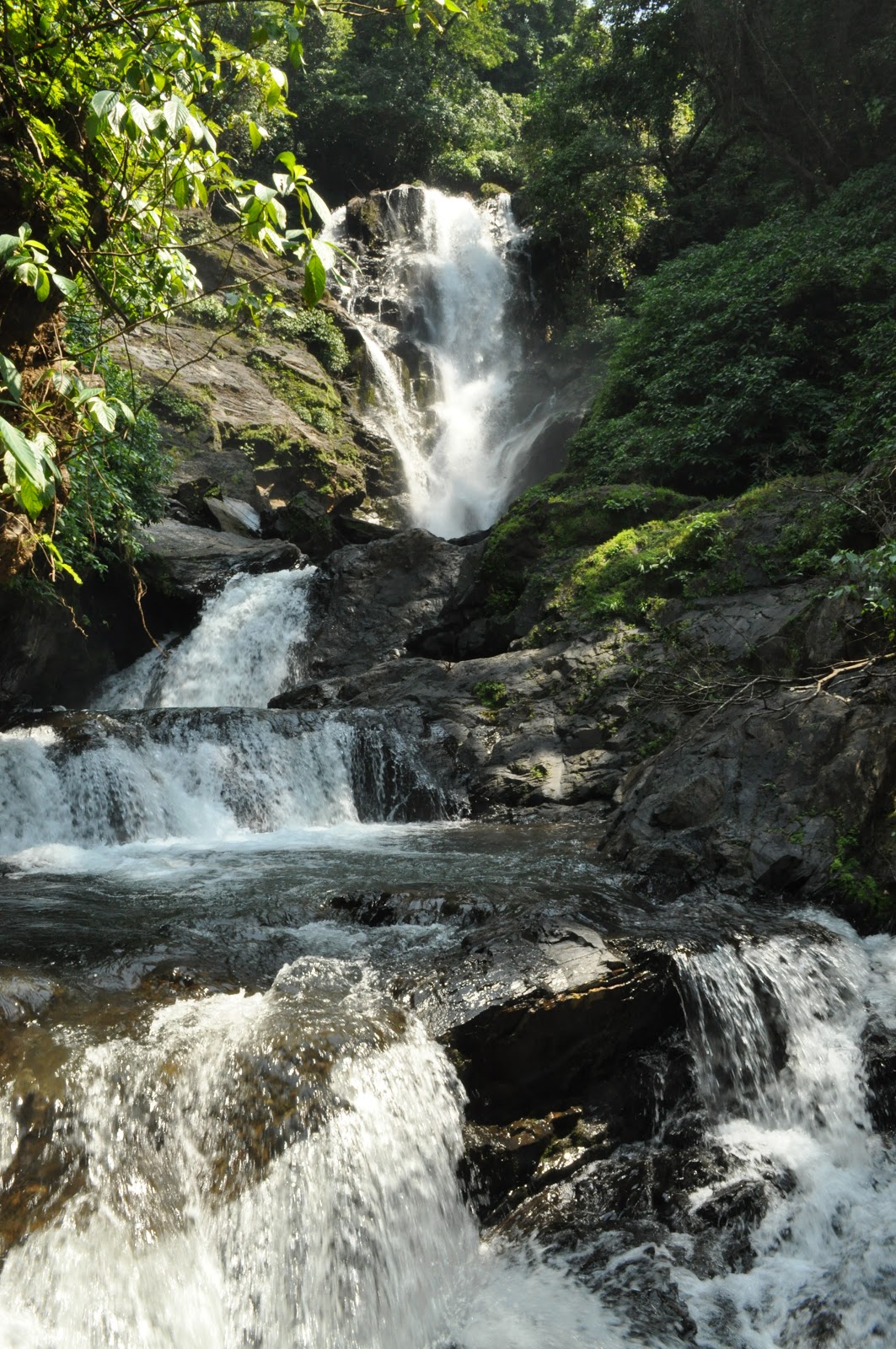
Viboothi Falls is a mere 8kms from Yana, but the winding and treacherous road makes it look longer than that. From the end of the motorable road it’s another 2 km walk to the waterfalls. Viboothi is as pristine as they come these days. Nestled in the Sahyadri Ranges and formed on River Gangavali, Viboothi gets its name from the limestone formations in the area. It is a 3-tier waterfall that forms a tiny pool, worthy of being called heavenly. The riverbed in this pool is haphazardly stuffed with big boulders, making it very perilous for the tourists. You have to be extremely stupid to dive into these waters. Unlike Sathodi, this is the kind of falls where you can relax, unwind, take a dip and refresh yourself in the pristine waters. It is an ideal picnic spot where you can spend a couple of hours playing in the waters and not know the time fly-by. Though Sirsi has many waterfalls, not all of them entertain the tourists to play in their laps. Viboothi is one such falls that embraces her visitors and leaves them wet, fresh and recharged. A must-visit waterfalls for your Sirsi itinerary.

Getting-there: 8kms from Yana.

Must-Do: Take a dip in the water and get totally refreshed and rejuvenated.
Must-Don’t: Diving into the pool and littering the place.

My Rating: 8/10

Sunday, November 04, 2012

Yana, Sirsi

Bhairaveshwar Shikara
It pays to have good friends, more so when these people are random guys you met in blogosphere. So, on Day1 of our Sirsi trip when we had given up hope on finding a room (all rooms in all hotels occupied, thanks to Dassera) in Sirsi, this blogger friend of a fellow traveler turns out to be our knight-in-shining-armor. All it took was one phone call and within minutes the six of us were given two of the best rooms in a hotel which belonged to a relative of our blogger friend. As if that magnanimity wasn’t enough, the hotel refused to take a single penny from us for our one-night-stay! A hot water bath and a good night’s sleep ensured all of us were all charged-up for the next day. A sumptuous breakfast later we were headed towards Yana.

Bhairaveshwar Shikara with Shiva temple
Yana is famous for two massive rock formations. Essentially, these rock formations are black crystalline limestone. The entire village of Yana is known for these rock formations. But there are 2 such formations that are of mythological significance, namely, Bhairaveshwar Shikara and Mohini Shikara. Yana is as much a geologist’s delight as it is for a pilgrim. The Bhairaveshwar Shikara is popular for a Swayambhu (self-manifested) linga. Add to that water drips on to this linga from the rocks thereby making the alliteration that it is holy Ganga flowing. However, the scientific reason for the formation of the swayambhu is attributed to phenomenon of stalactites and stalagmites.

Most of the pictures you find of the two shikaras on internet do no justice compared to the real deal. These are massive rock formations, standing as tall as 120 metres (Bhairaveshwar Shikara) and 90 metres (Mohini Shikara). These rocks are not without its share of mythological stories and prominence, as the names suggest. As per the mythological stories, the demon king Asura through persistent penance obtained a boon from Lord Shiva whereby on whomsoever’s head Asura places his hand, would turn to ashes (hence the name Bhasmasura). But Asura turns a Frankenstein’s monster and wants to test his strength on Lord Shiva Himself. After being chased by Asura, Shiva seeks refuge and advice from Lord Vishnu. Vishnu takes the form of damsel Mohini and entices Bhasmasura with her beauty and dance. An infatuated Bhasmasura agrees to a dance competition between the two. In one of the mudras (dance pose) Mohini places her hand on her head which an unsuspecting (and blindly in love) Asura copies, only to be turned into ashes by his own foolishness. The resulting combustion was believed to be so intense that it blackened the limestone formations of entire Yana. The Bhairaveshwar Shikara (Shiva’s Hill) and Mohini Shikara (Mohini’s Hill) thus got their respective names and temples (Mohini Shikara houses a Parvathi temple).
Mohini Shikara
Just like in Banavasi, the priest of the Shiva temple here gives all the devotees a briefing on the mythology of this temple. The pradikshina of the temple here is probably the longest and toughest of them all as it involves walking around and between these rock formations on barefoot. Once you are done with Bhairaveshwar Shikara, there are steps downhill that takes you to Mohini Shikara and the Parvathi temple.
This area once used to be a dense Sahayadri forest. And it took a trek of nearly 17kms from civilization to just reach these rocks. But crass commercialization and road-laying has done away with all this. And now visitors need to walk just half a kilometer from where they can park their vehicles. The day is not far behind where you can drive right up to the base of these hills. There’s a popular saying in these parts of the world - Sokkidhavanu Yanakke hogutaane, rokkiddhavanu Gokarna ke hoguthane, meaning, the one with tremendous guts and determination goes to Yana and the one with money bags goes to Gokarna. Unfortunately that is no longer true in these times of rapid and unbridled development.

Getting-there: Around 40kms from Sirsi town.

Must-Do: Check out the rock formations and the Swayambhu.
Must-Don’t: Littering and Vandalism. 

My Rating: 8/10

Information Courtesy: Wikipedia, OurKarnataka

Tuesday, October 30, 2012

Sathodi Falls, Yellapur

This was my second attempt at getting to Sathodi Falls and yet again for a briefest of moments I felt my chances of getting to see this waterfall receding, just like the sun setting in the horizon. The first attempt was a failure because accessibility was an issue. After reaching Yellapur, I found that there were no buses that go to Sathodi Falls. I knew it wasn’t wise to hire a Jeep or a rickshaw as they would charge me buckets. I was told that youngsters there offered to take you to Sathodi for a nominal amount. As it turned out, the nominal amount was Rs. 400 – something that I was expecting the Rickshaw-wallas to demand. I decided to drop the plan and instead go to Magod Falls. But even that didn’t materialize since the bus timings were very erratic and less frequent.

But this time round I was travelling with a group and with our own transport – a Tavera. The threat to our chances was however from the receding daylight. Our first challenge was to enter the forest area before 6:30PM before the gates close. And the second was to spend enough time enjoying the view and yet get back to civilization before it’s too dark. Sathodi is a 28km drive through the forests from Yellapur town. The roads are in a bad shape for the first 23kms. For the last 5 kms there is simply no road. Ok.. Im exaggerating a bit here. There is indeed a mud road for the last 5 kms but it’s in a pathetic condition. The rains make the road even worse with loose soil and slippery slopes.

With the menacing road taking a toll on the vehicle and the eager-to-retire sun looming over our heads, we started questioning the rationale of going ahead with our plan. Would the destination be worth the journey? Would we be able to spend at least 10 minutes there? Even if we do, are those 10 minutes worth the trouble we took just getting here? What if we have a flat tyre on the way back? Is it safe to spend the night in this jungle? Just as all these questions were hovering around inside the confines of our heads, we got our first glimpse of the backwaters of Kodasalli Dam. And just like that, our apprehensions started disappearing. We were now more than eager to get to the waterfalls.

We finally reached the check-in point of the falls where we paid a nominal entrance fee and quickly made our way to the falls. A one kilometer walk later we gaped with open mouths at India’s little Niagara falls. I had to admit that the pictures you see of Sathodi in the internet do no justice to the real deal. Even though you don’t get to go near the foot of the falls, the view is pretty intimidating. While most waterfalls I’ve seen till date are tall, and single or multi-tiered, this one was w-i-d-e. And thanks to all that rain for the last couple of weeks, Sathodi was a decked-up princess. Anybody with half a brain would know better than to venture into the water. At this time of the year Sathodi was strictly a viewing-only waterfall. Even though we had set ourselves a deadline of 15 minutes to reach back to our vehicle, half an hour had already passed. Not completely content with the amount of time we spent here, we had to drag ourselves back to the car. Our apprehensions of a flat tyre were highly misplaced and we reached Yellapur, and subsequently Sirsi, incident-free.

Getting-there: Sirsi->Yellapur ->Sathodi (Follow the signboards at Yellapur)

Must-Do: Start early so as to spend enough time there and get back safely
Must-Don’t: Adventurism or heroism in the rapid waters.

My Rating: 8/10

Sahasralinga, Sirsi

The literal translation of Sahasralinga means a 1000 Lingas. And that’s precisely what you get to see here. On the banks of river Shalmala are carved hundreds and hundreds of Shivalingas and Nandis (Basavannas). It is believed that for every Linga, there is a Nandi staring at it. Currently there are far too fewer lingas, and even the ones present have suffered some damage over the years thanks to the force of the ravenous waters. Even then the sheer number of Lingas and Nandis is sight to be seen to be believed, notwithstanding the fact that we went there at a time when the water flow was high.

These Shiva lingas were built by King Sadashivaraya of Sirsi. It is best to visit Sahasralinga during the dry seasons, when the flow of water is pretty less. Sahasralinga is 10 kms from Sirsi. A recent addition to this tourist location is a hanging bridge built across the river to connect neighboring villages. Since the flow of water is comparatively gentler, this place can also double up as a picnic center. Children might enjoy play in the water here.

Getting-there: About 10 kms from Sirsi en route Yellapur.

Must-Do: Visit during the dry seasons to see more of the lingas surfacing.
Must-Don’t: Vandalism and Littering.

My Rating: 6/10

Monday, October 29, 2012

Madhukeshwara Temple, Banavasi, Sirsi

Long before colonial Bangalore was deemed the capital of Karnataka, there was a lesser known capital for the state, which goes by the name of Banavasi. Set up in the 9th Century AD by the Kadamba dynasty, Banavasi was known to be the earliest known capital of Karnataka. As with most dynasties of that era, the kingdom revolves around the main temple in area. Madhukeshwara Temple occupies that significant stature in this regard. So prominent was Banvasi and the Madhukeshava temple that the temple originally built by Kadambas were renovated/extended by Chalukyas and the Hoysalas. As a result one can easily notice the different architectural styles starting from the garba griha to the mantapas. And yet there is no denying the fact that the mastery of the Hoysala craftsmen shine through. Hoysala craftsmen are top-of-the-class pioneers in stone craftsmanship. And their style is so distinct and uniform you can identify it pretty easily. The famous Hoysala artisan Jakkanacharya is being credited for the Hoysala additions. Im really beginning to doubt the existence of this character called Jakkanacharya. He’s been being associated with every Hoysala Temple dotted across the state. So unless he’s a superhuman sent from outer space, it’s highly unlikely that he would have worked with each of these temples

Onte Kallu Mantapa

Banavasi is a true-blooded Kannadiga pride temple town. Not only was it considered the first capital of Karnataka, it was also the birthplace for Kannada’s first poet, Adikavi Pampa. Few coins discovered here a few years ago, date back to the 5th Century with Kannada inscriptions on it. This means that the existence of a mint factory here can be considered amongst the oldest in the country.
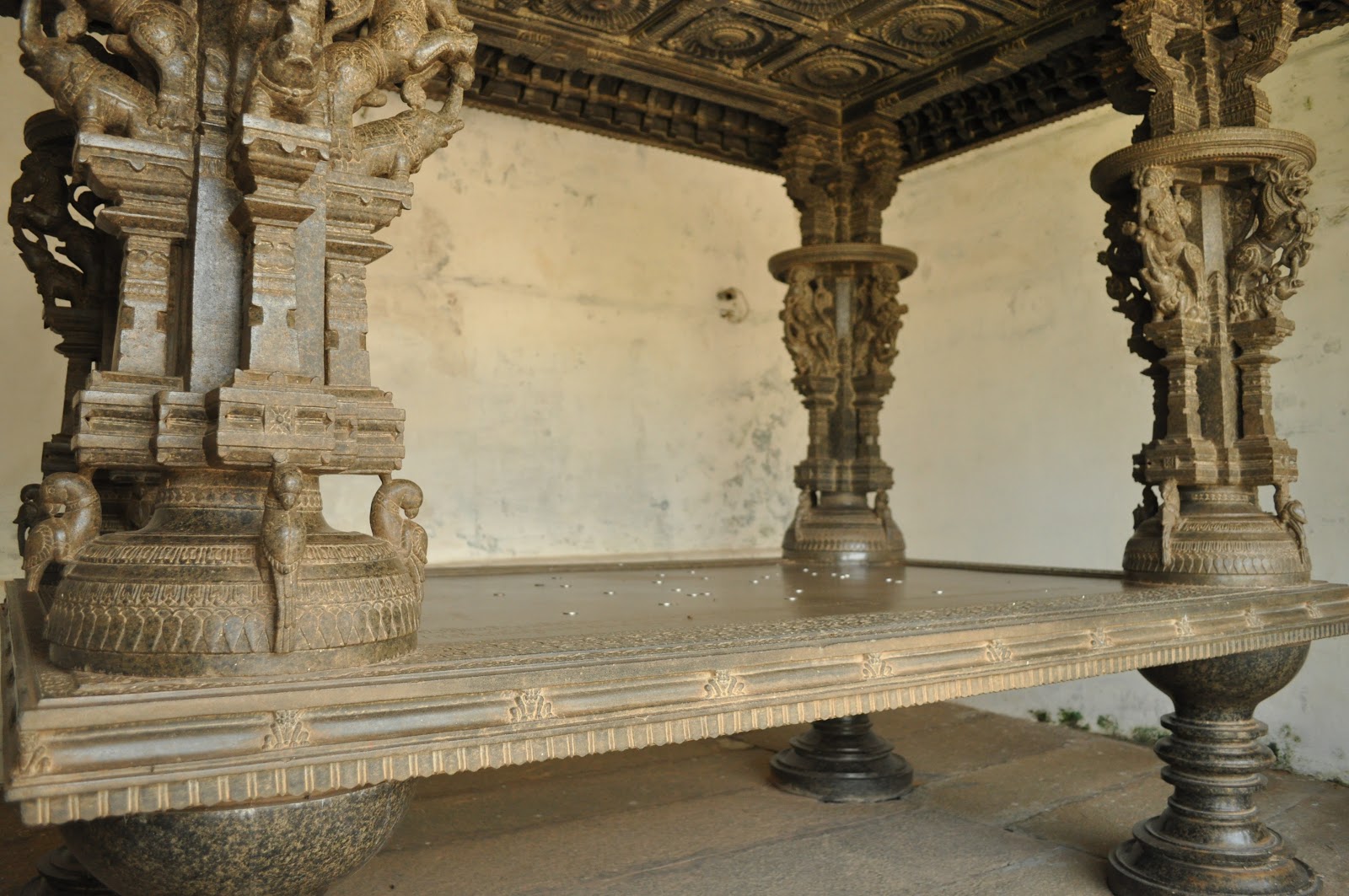
When we arrived here, we found out, much to our dismay that there were no ASI guides who could give us a sneak peek into the history of this magnificent temple. But just as we were loitering around clicking pictures, a priest herded us together and starting giving us a guided tour of the temple. Even though we knew pretty well that there was no such thing as a free meal, we didn’t mind paying the priest for an insight about the temple.  The priest began by giving a brief history of the temple built by the Kadambas and subsequently renovated and improved upon by the Chalukyas and Hoysalas. He told us the reason behind the Shivalinga being called Madhukeshava. The large linga here is in the color of honey (madhu) contrary to the black that we see elsewhere. He also talked about the specialty of the large bell outside the garba griha. This bell made from pancha loha (5 metals) is unique because the gong of the bell rings for close to a minute. He then showed us the Triloka Mantapa carved out of a single stone. It is undoubtedly the work of the Hoysala craftsmen. It goes without saying that such artwork can only be produced from the Hoysala breed of artisans. This is followed by the trademark Hoysala pillars, that’s a common garnish in every Hoysala Temple. The concave and convex reflective pillars not only accentuated the viewing experience of the performing dance artists but also speaks volumes of the mastery of these stone artists.
Can you spot the right eye of Nandi?
The Onte kallu Mantapa (single stone mantapa) is yet another classic from the Hoysala staple – again, carved from a single stone. The other notable and no less artistic brilliance is the Nandi statue. The first thing most of us might straight-away notice is that the Nandi is not directly looking at Shiva but is rather looking slightly to the right. The reason behind this is that while Nandi’s left eye is looking directly at the Shivalinga, its right eye is looking at Parvathi which is separate temple adjacent to Shiva’s. Such is the mastery of the stone artisans of that era that despite a maze of pillars, the right eye of Nandi is transfixed on Parvathi Devi. Unbelievable? Well, you can confirm it yourself by standing in front of the Parvathi temple and looking at Nandi. Another important attraction here is the Ardha Ganesh. This statue of Lord Ganesh is split vertically right at the middle. It is believed that the other half is in Kashi.
These are only some of the stand-out features of this temple. By the end of it all we were left dizzy with amazement. With the Sun beating down hard we decided to spend a little more time admiring the place. After all it’s not every day you get to be a part of history. All that textbook knowledge of our History lessons look so worthless compared to the couple of hours we spent here.
Now did I say there’s-no-such-thing-as-a-free-meal a while ago. Ok, I take that back, because there was a free anna daanam in the temple served at exactly 1PM. We devoured the hot rice, blistering sambar and the super cool majige like there’s no tomorrow. With a content stomach and heart we started for the next leg of our Sirsi trip – Sahasralinga.
 
Getting-there: Approx 30 kms from Marikamba Temple.
Must-Do: Ask the priest for a guided tour. Free Anna Daanam at 1PM.
Must-Don't: Vandalism and Littering
My Rating: 8/10

Saturday, October 27, 2012

Marikamba Temple, Sirsi

A trip to Sirsi has been in the offing for quite a while. The plan was made at least 2 years ago. The idea was simple – cover as many waterfalls as possible in given time between August and October. The timing was important because this was the time when the monsoons would have abated leaving the waterfalls packed to capacity. But as the plans got serious and looked on the verge of being conquered thanks to a few enthusiastic co-travelers cum nature lovers cum awesome friends, the plan started taking a different shape and dimension.  My biggest learning before and during this trip was that Sirsi was not all about waterfalls. This sleepy little town is rich in cultural, linguistical and mythological heritage. Sirsi is as much about the cultural heritage of Karnataka as it is about the waterfalls. Add to that, there are so many places of mythological significance that it is difficult to cover Sirsi in a weekend. You definitely have to devote at least a couple more weekends to experiencing Sirsi.

After Alemarigalu’s planned Sirsi trip got cancelled because of drop-outs this time we fixed a quorum of 5 members to make a trip out of it. And 5 we were to explore the wonderful land of Sirsi. Our first stop after freezing bath in a canal was Sri Marikamba Temple.

Sri Marikamba Temple is a 17th Century temple located at Sirsi in Uttara Kannada. Marikamba is believed to be the Goddess of Power by Her devotees.  The seven foot tall wooden idol of the deity was resurrected from a tank near Hangal and a temple built for Her in the year 1689. Local puranas mention the deity as Renuka or Yellamma. She is also referred to as Doddamma – elder sister to all younger Mariammas installed in different villages and towns. She is believed to control evil spirits and epidemics. So in order to appease Her, devotees used to offer animal sacrifice. But all that changed in 1933 when Gandhiji  visited Sirsi but refused to enter the temple considering the brutal animal sacrifices that were performed here. Distinguished citizens like SN Keshwain and Vitthal Rao Hodike started educating the masses against this inhuman practice. They even went to the extent of kidnapping the buffalo the night before the sacrifice and have the courage to face an angry mob. Eventually the masses relented and the practice of animal sacrifice was finally banned.

The Marikamba Temple is also famous for its Kavi art. The temple walls are adorned with artwork from famous local artists. These wall murals depict episodes from the Ramayana and Mahabharata. The first impression of the temple is that it looks nothing like a South Indian temple and that impression stays throughout, thanks to the wall murals. It is unlike any temple you will ever see in South India. Here’s why you should you visit Marikamba Temple:

1.       It’s bang in the middle of Sirsi town

2.       The wall murals on the temple depicting episodes from our epics

3.       Take inspiration from the fact that God will be appeased even if animal sacrifices aren’t done

4.       Learn about how the courage of two brave and educated men can change age-old customs for the better.

5.       It is en route Banavasi Madhukeshava Temple.

6.       Because 5 reasons are good enough to go there!

Getting-there: Right in the heart of the town.
Must-Do: Check out the murals adorning the temple
Must-Don’t: Animal sacrifice of course. Photography of the deity.
My Rating: 7/10

Information Credits: Kamat's Potpourri

Chikka Tirupathi, Sarjapura

We wanted to make the best use of our Ayudha Pooja holiday besides the fact that we wanted to take our little one out on a long drive.  Considering that the little one hadn’t gone on a long drive yet, we wanted to go somewhere near, yet comfortably out of Bangalore. After a good look at the options, we zeroed-in on Chikka Tirupathi. Comfortably placed at 32 kms from house, the ride to this miniature Tirupathi seemed ideal.

Chikka Tirupathi is located 10km further of Sarjapura. There’s no chance you will get lost reaching this temple. It’s just one straight road till Sarjapura. From here you need to take a left. 10 kms later you will be at the door step of Lord Venkateshwara. Now if you are wondering why this temple is called a mini-Tirupathi, it is because this one is a replica of the actual temple in Tirumala. Also, all the festivities and poojas performed in Tirumala are also performed here. There are also some mythological stories associated with this temple.  It is believed that  Agni during incineration of the forests of herbs, causes burn injuries on serpent Lord Takshaka. Enraged by this act, Takshaka bestows a curse on Agni that he would lose his powers. Disturbed by this event, He rushes to Lord Krishna for advice, who suggests Agni to perform a penance to appease Lord Vishnu. A dedicated penance later, a pleased Lord Vishnu performs a shaapa vimochana for Agni. A joyous Agni  builds a temple for Lord Venkateshwara, aptly named, Prasanna Venkateshwara.

Surprisingly, there were hardly a handful of devotees, especially since it was a festive day. A quick darshan later we spent a few lazy moments there before heading back to Bangalore. On the way back, we stopped at the Kochu Guruvayoor temple, but it was already closed for poojas.

The ride till Dommasandra is nothing worth writing about. Its uneven and pot-hole ridden. However the road does better after Dommasandra till Sarjapura. Driving through the narrow market lanes of Sarjapura is a nightmarish experience, especially when careless people do not think twice before leaving a scratch on your car. The final 10 km stretch is beautiful ride through the idyllic villages. The well-laid winding roads and cool breeze settles the case that you are finally out of Bangalore – if only for a short while.

Getting-there: Take right at Iblur Junction on Sarjapur Road/ORR and continue till Sarjapura(approx. 20kms). After Sarjapura town take left and follow the signboards for the final 10 kms.

Must-Do: Drive carefully through Sarjapura town. Best to go in a hatchback than a sedan.
Must-Don’t: Littering along the way and near the temple.

My Rating: 5/10

Photo and Content Credits: Alemaari

Tuesday, September 11, 2012

Heritage Wine Tour, Chennapatna

After a heavy dose of devotion at Revannasiddeshwara Betta and Ambegalu Krishna, it was time to unwind a bit. And unwind we did, with the constant heady aroma of fermented grapes culminating in a first-ever wine tasting experience. Of course I've had wine at numerous dinner tables before, but it was the first time doing what I would like to call, wine-appreciation. A few kilometers from Chennapatna a left deviation on the Mysore Road adjacent Kadambam Hotel brings you on the doorstep of one-of-the-few-of-its-kind Winery - Heritage Grape Winery. The Wine Tour costing Rs.150 begins with a tour of the Winery where they explain the process of Wine making, right from de-seeding, de-stemming, fermenting, purifying, bottling and racking ends with a wine-tasting.
Your tour guide will also explain the types of wine being produced, the ones available in the market, the process of making it, the kind of grapes used to make these wines and the time it takes to make these wines. The best variety - the French variety - is a separate process in itself taking close to 1 year to produce them, compared to a couple of months for the normal variety. The Winery also has a 4 acre Vineyard where the French varieties of grapes are grown.
After that comes the best part - Wine-tasting. The heritage Winery produces 5-6 varieties of wine. But before you drink the wine there is a short discourse on wine-appreciation. Wine is supposed to be enjoyed by three senses - sight, smell and taste. A glass of wine needs to be first looked at, to assess its texture, color, age and flavor by holding the stem of the glass. You then need to swirl the wine a little and nose it to smell the aroma released by the swirling. Then you draw a sip from the glass and roll it around your tongue to feel the wine. Well it’s a process to say the least, but that is how it is best enjoyed by wine drinkers around the world.

The standard Red Wine, the Shiraz, the Cabernet, the Chenin Blanc and the Sparkle are some of the wines we tasted, much to our delight. This was followed by a video being played charting the history of Wine and its present day consumption and varieties. At the end of it all, it’s a unique experience that can be cherished for a long time.

Getting-there: Bangalore-Mysore Road. After Chennapatna take left at Kadambam Hotel. Follow the red signboards for the next 5 kms.

Must-Do: Learn the art of wine appreciation. Buy wine at MRP.
Must-Don't: Miss it.

My Rating: 6/10

Ambegalu Krishna Temple, Chennapatna

Rejuvenated from the soothing breeze of Revannasiddeshwara Temple, we headed back to Ramnagara and towards Chennapatna. On the outskirts of Chennapatna is a sleepy town called Doddamallur. And the centre of attention of this town is the Sri Aprameya Temple, some 50 meters from the highway. Lord Aprameya (another form of Lord Vishnu) is the presiding deity here. The temple also houses the Ambegalu (Crawling) Krishna Temple and the Rama Temple. This temple is rich in history and stories from the past.
The temple is believed to be 3000 years old. It is believed to be built and expanded by Chola King Rajendra Simha. It is said that the temple is standing on sand rather than a strong foundation. Apparently Lord Rama stayed and prayed here before leaving to Lanka to rescue Sita Devi. It is believed that Sages Kapila and Kanva still live in the temple in some form or the other. Apparently even today you can hear the sound of the garba griha door opening and the sound of performing poojas and tolling of the bells can be heard once the temple doors are closed. Spooky...

But it’s the Ambegalu Navneetha (Crawling Krishna) that is more popular in this temple. The idol of baby Krishna crawling with a handful of butter that has the devotees coming in large numbers to this temple is believed to installed by Sage Vyasa. It is believed that childless couples praying to Ambegalu Krishna are blessed with children after their visit. These couples later return to the temple and tie little cradles as a thanksgiving to the Lord. Legend also has it that some 130 years ago the then Maharaja of Mysore on a visit to Aprameya Temple was so enamored by the Ambegalu Krishna that he took the idol back to his palace to worship it. That night he dreamt about Lord Krishna appearing in his dream and ordering him to return the idol to the temple, failing which great misfortune will befall him. The King dismissed the dream and did not comply with the Lord's demand. Soon enough a part of the King's Palace was consumed in a fire and he promptly returned the idol to its rightful place in the temple.
The town of Doddamallur has a more recent claim to fame. Apparently this is where the next re-incarnation of Sai Baba (Prema Sai) will be born. Numerous devotees of Puttaparthi Sai Baba have been scouring the village looking for their next demigod. Should the prophecy be (made to) fulfilled, this town will lose its significance as a historic and mythological hotspot and end up being a stupefying and fanatical village.

Enough devotion for the day, time to unwind at our next stop.

Getting-there: Bangalore-Mysore Road. On the outskirts of Chennapatna is a village called Doddamalur. The temple is in this village right on the highway on your left while going towards Mysore.

Must-Do: Take a closer look at the beautiful idol of Ambegalu Krishna
Must-Don't: Photography, vandalism and littering.

My Rating: 6/10

Ambegalu Idol Picture Courtesy: Vibaa