Showing posts with label Vijayanagara Trail. Show all posts

Wednesday, June 22, 2011

Someshwara Temple, Kolar.


The brand new Ritz lying in the parking lot for a week has been crying for attention. With the arrival of the weekend, we took her out for a spin. Even though the plan to go for a long drive was made in the eleventh hour, there was no shortage of destinations to choose from. We zeroed-in on Kolar. Even the places we to see in Kolar was a no-brainer. Since I’ve already to Kolar once, there was no need to take a peek at Google maps either. All I needed was a good night’s sleep so we can start early in the morning. But that was not to be, as I kept tossing and turning in bed till close to midnight and then very reluctantly dragged myself out of bed at 4 in the morning.

After picking up a couple of friends from KR puram, we were quickly onto NH4 headed towards Kolar. First stop was Kamat Upachar (or was it Lokaruchi? What’s the difference between the two anyway?) some 10 kms before Kolar. Next up we drove right up to Someshwara Temple in Kolar town after asking for directions from the locals. The Someshwara Temple was built in the 14th Century by Vijayanagara Empire. The temple was built in distinct Vijayanagara style with Chinese, European and Thai influence. This inclusion of foreign styles is a prominent feature of Vijayanagara architectural style as witnessed in Hampi.

The temple complex, among others, has a huge Mantapa, Yoga Shaala, Kalyana Mantapa and a shrine for Goddess Parvathi. The temple was unusually quiet when we were there. Just a handful of devotees came along at that hour, which was fine by me, as I hate crowded temples. We spent a few leisure moments relaxing and taking pictures before we decided to move to the next item on the list – Kolaramma temple.

Getting-there: Take NH4 out of Bangalore. Some 60-odd kms later you will find yourself at Kamat. Make sure to have some food here, since there aren’t any good hotels in Kolar worthy of mention. Some 10 kms later take a left deviation to Kolar. You can ask for directions once you are in Kolar.

Must-Do: Have food at Kamat before you get to Kolar. A good camera is handy to capture to the splendor of Vijayanagara style of architecture.

Must-Don’t: Destroy the serenity and aesthetics of the place.

My Rating: 6/10

Monday, May 02, 2011

Hampi, Day II

Underground Shiva Temple
Day II Highlights

We started our second day in Hampi with our bicycles, a route map and the scorching sun for company. First stop was the Underground Temple. By climbing down some 30 odd steps you’ll find yourself at the Underground Shiva Temple. Well, that’s as much underground as it goes here. From the outside the temple is well maintained with a beautiful lawn and garden. But the inside of the temple, is something you might want to avoid. The inner sanctum of the temple is clogged with dirty stinking water. The stench of bats, doesn’t make it any better either.


But the architecture of the Temple is worth a second glance. It reminds one of the marvelous Hoysala temples in Belur and Halebidu.

Hazara Rama Temple

Next up was Noblemen’s Quarters. Pretty much nothing is left of the quarters, but you get the idea that it once was indeed some residential area.

With the blistering sun above us, we decided to move-on. Next up was the Zanana Enclosure, which housed the Lotus Mahal and Elephant Stables. The Lotus Mahal brings back memories of Nizam architecture. It is a beautifully constructed hall. The symmetry of the structure is just mind bogling. Adjacent to it is the Elephant Stables. It has been so majestically built that only the Elephants can do justice to its size and stature. We spent a few leisure minutes resting in the shade and regain our energy for the remainder of the sites.

Lotus Mahal
 
Hazara Rama Temple was next on the map and that’s where we were headed. This is another temple that was aesthetically built. But obviously it was not built to last forever. Parts of the gopuram have been decimated by nature’s fury over the years. But the rest of the temple looks to have stood the test of the times.

Next up was another set of ruins which housed Mahanavami Dibba and the Stepped Tank . Stepped Tank was the last of the ruins we visited in Hampi. It surely was the icing on the cake and definitely not in ruins.Every stone built into that tank holds its place proudly for the world to see. Personally,, this was the best thing we came across in Hampi. You can sit and admire this masterpiece all day long, despite the merciless Sun. Nowhere else will you see such precision symmetry.
Elephant Stables

The Stepped Tank ended our Hampi weekend on a high note. We took back memories of some great works of art in stone, for every stone in Hampi had a story to tell.


Must-Do: Rent a bicycle/moped/rickshaw/car – whatever works for you.

Must-Don’t: Littering. Giving alms to the beggars, especially children.


The Queen's Bath/Stepped Tank
Best-Time-To-Visit: Probably during the rains/Hampi Festival (December).

My Rating: 8/10

Wednesday, February 23, 2011

Hampi, Day I


Vittala Temple
 Day I Highlights:


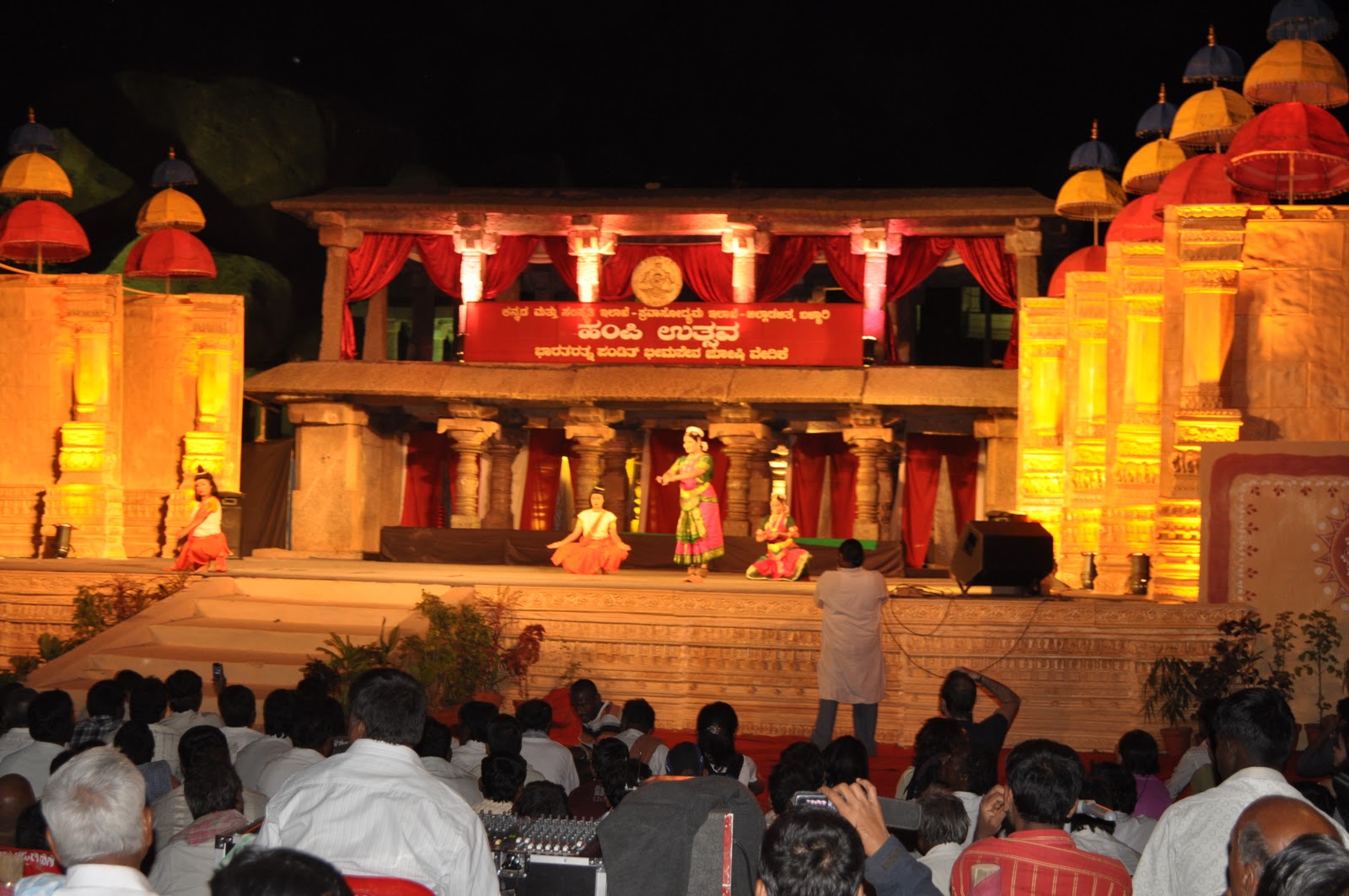
Vittala Temple: Now this is a “must-see” when you are in Hampi. And this is where the famous Stone Chariot is located. We always engaged a Guide in such places to show us around. But with the on-going Hampi Festivals, none of the ASI guides were around. Apparently they were taking care of arrangements for the festival. But having struck a conversation with a “slightly off-guard” guard, if you know what I mean, he was ready to show us around for a few bucks. Well, we had nothing to loose, it was either way better than having no guide at all.


Stone Chariot at Vittala Temple

In the end the guard turned out to be alright, despite his wavering speech. He also helped us hear some sounds from the hollow musical pillars. The main temple complex with the musical pillars was however out-of-bounds for tourists owing to renovation work. The other star attraction at the Vittala temple is the Stone Chariot. This monolith Stone Chariot is exquisitely carved and speaks volumes of the great Indian craftsmanship.
Japanese style architecture

Achyutaraya Temple and Matanga Hill: Achyutaraya Temple is a desolate and abandoned temple situated next to Matanga Hill. I feel it’s mandatory that you climb Matanga Hill if you visit Hampi. You would get a bird’s eye view of Hampi, it’s surrounding villages and millions of rock formations as far as the eye can see. Apparently this Hill offers the best sunset on view, but it was way too early for us to wait for the sun to set. Bottom line – do not miss it.

Anjeyanadri Hill: Another must-see location in Hampi. Why? Because this hill is believed to be the birthplace of Lord Hanuman. Getting there is a little tedious. You first need to cross the river Tungabhadra on a coracle (about Rs 50 per head), then walk some 4 kms to reach the foot of the hill and then climb some 600 odd (or more) steps. But if you have money to splurge, then you can take a longer coracle ride and reach a kilometer near the foot of the Hill. But then it’s all worth the effort considering the tranquility and significance of the location. From atop the hill there are 3 views on display – rocks, ruins and greenery. If you have the time, you might also want to check out Lord Sugriva’s hiding place, some 3 kms from here.

There are umpteen other ruins and structures that you’ll find along the way. But I’ll leave it to you to explore them. Also, if you are an Athletic person, you can cover all these places on foot with a coracle ride pitched-in for Anjaneyadri Hill. 


Precautions:
  • Carry enough Sunscreen lotions and water bottles, since it is extremely hot and dry.
  • The best time of the year to visit would be November, which is also the usual time of the Hampi Festival.
  • To see the mentioned places in this blog, you need not hire a bicycle, since the terrain is difficult and it's easier to just walk.
  • If walking is not an option for you, you can hire a Taxi or a Autorickshaw.
  • it's better to coincide your visit with Hampi Festival, but be aware of the mildly uncivilized local population.

My Rating: 8/10

Tuesday, February 22, 2011

Hampi, Hospet

2010 has been a mixed year for us in terms of travelling. Though we didn’t see too many new places, whatever we saw more than made-up for what we didn’t. The year began on a promising note with Goa. This was also the year we discovered the glory of Hoysala Kingdom. The temples of Halebeedu and Belur set us on a Hoysala Trail. The architectural splendor of ancient India had a cascading effect and we started exploring other historical places like Badami and a few other Hoysala temples. Another first that I managed to achieve was the famous Snake Boat Races of Kerala – Aranmula Boat Race. Having been to the beaches, famous temples and the like we decided to head to the hills. And we chose, probably the best hill station in south India – Chikmagalur, to complete a satisfying year for travelling.


2011 promises to be a good year too. And we decided to kick-start it with a prominent destination. Well, to be more honest, we didn’t really plan it that way. It was almost an impromptu plan. The deciding factor was an Ad in the papers announcing the Hampi Festival. Usually, the Hampi Festival happens during November of every year. But this time round it was moved to January to coincide with the 500th year of the coronation of Emperor Krishnadevaraya of Vijayanagara kindgdom.

An overnight train from Bangalore will bring you to Hospet, the nearest railway station to Hampi, 13 kms away. Now Hampi is world-famous tourist destination, and like every popular tourist place in India, people will try to trick at the drop of a hat. Hampi is no exception. There are many options reach Hampi from Hospet. You could take a taxi, Autorickshaw, shared 7-seater autorickshaw or bus. Depending on the size of your wallet, you can choose your ride. The Autorickshaws cost a whopping Rs 100-125, whereas the shared 7-seater rickshaw costs a mere Rs.15.

Accommodations in Hampi is nothing spectacular to talk about. There are a handful of houses-turned-guesthouses that takes care of accommodating the tourists. You cannot but wonder that these guesthouses are overpriced, especially what with the Hampi Festival shooting prices through the roof. We paid Rs 750 for a lousy room in Santhosh Guesthouse, which according to a banner is recommended by “Lovely” Planet. But their roof-top restaurant is probably the best in this sleepy town. All guesthouses/ shops/ restaurants are located in a single street leading to the Virupaksha Temple. There are however good hotels in Hospet, if you want to stay comfortably.

We spent two days in Hampi and that’s how I’ll classify the blogs here that way: Day I and Day II.

Day I started with us renting a bicycle for Rs 50 a day which in hindsight was a complete waste of money for that day. We went about exploring the Tungabhadra side of Hampi. On this side of Virupaksha the major attraction is the Vittala Temple, the King’s Balance, the Pushkarni, the Achyutaraya Temple, Matanga Hill, Hemakunta Complex, Lakshmi Narasimha Temple and the Anjeyanadri Hill among others. Well, the list doesn’t end there but those are what we could cover! And yes, if you are a budget traveler you can cover all this on foot/coracle.


Day II we covered Virupaksha Temple, Krishna Temple, Underground Temple, the Noblemen’s quarters, Royal Enclosures, Zanana Enclosure, Lotus Mahal, Elephant Stables, Mahanavmi Dibba, Hazara Rama Temple and the Stepped Tank. Hiring a bicycle or moped is an absolute necessity here.

Words of Caution:


  • It’s extremely hot in Hampi. Make sure you keep yourself hydrated. Do not miss an opportunity to buy water bottles wherever available.
  • There are way too many kids on the street begging for alms. Do not encourage them.
  • Foreigners should try to avoid the locals as much as possible. They can get a little “probing” if you encourage them.
  • Negotiate with all vendors before doling out money.