Showing posts with label Rivers. Show all posts

Sunday, March 17, 2013

Chankapur Dam, Maharashtra.


The only information we had about Chankapur Dam in Nashik District of Maharashtra is that it does exist. And yet we reached there pretty much without getting lost. All thanks to smartphones and GPS apps. Chankapur Dam is about 40-odd kms from Saputara.

The idea was to reach Chankapur Dam a little after noon and then probably take a bath in the water and head back Surat. And we pretty much stuck to the plan except the bathing part. Upon arriving at the landing point closest to the water (as far as the GPS shows), we found the water to be too muddy for a bath. So shed our plans of taking a bath and instead relax a bit before heading back. Thankfully, there was a tiny shack built to take refuge from the beaming Sun. Even though there was no name scribbled on this gift-wrapped gift, I’m ready to believe it was sent from God. After all, here we were in the harshest of summers sitting on the banks of river Girna, nestled between a hill on one side and an idyllic village on the other and staring at a 41m high dam in the distance.

The Sun was so harsh that none of dared to put even a finger out of the shade while resting in the shack. We spent about an hour resting and having conversations on topics ranging from food, travel, cricket et al. As the conversation steered towards their college days, my own mind wandered into the horizon. And how I managed a cat nap I don’t know, but it was one of the best I’ve ever had. And then it was time to head back to Saputara, where we had a unusually heavy lunch before starting on the return leg of our bike ride to Surat. On the whole it was one of the best rides I’ve ever had. And definitely the longest in a day. We had covered close to 450 kms in a day.

Getting-there: From Saputara cross the border and enter Maharashtra. After some 5 kms on the highway there’s a left deviation to Chankapur road.

Must-Do: It’s best to carry a GPS app with you, or simply rely of directions from people.
Must-Don’t: Avoid coming in the summer.

My Rating: 5/10

Monday, January 28, 2013

Kukke Subramanya Temple, Subramanya


The Kukke Subramanya Temple in Subramanya village of Dakshina Kannada is a temple of ironies. Devotees from across the country come here to get rid of their Sarpa Dosa (Serpeant Curse). And yet this temple can into existence because Vasuki, the King of Snakes, wanted to protect his ilk from the wrath of Garuda. Vasuki earnestly prayed to Lord Shiva who sent Subramanya to Vasuki as a reward for his penance. Subramanya has ever since been worshipped as the protector of snakes. And that’s not the only irony. The temple houses a silver Garuda tower which is believed to be erected to protect devotees from the poisonous fumes of Vasuki’s breath. Another interesting tidbit about this temple is that devotees enter the courtyard from the back and go round to east-facing entrance.

Interesting tidbits and anecdotes and mythology aside, the Kukke Subramanya temple is a must-visit in the pilgrimage circuit of Karnataka and South India. The majestic Kumara Parvatha in the background, the pristine Kumara Dhara river flowing by the temple and quaint little temple town nestled in the Western Ghats is worth a visit. Subramanya is easily accessible from Bangalore, Mangalore and Hassan. Trekking enthusiasts and devotees arrive here in large numbers. Whether it’s trekking in nature’s lap in the most grueling way or getting rid of Sarpa Dosas from this life or the previous or just getting away from the monotonous city life to a relaxing weekend filled with devotion and nature’s abundant beauty, Kukke Subramanya is one of the ideal locations to fulfill your need.
Getting-there: Overnight buses are available from Bangalore to Subramanya town. There is also a railway station at Subramanya.
Must-Do: Take a dip in Kumara Dhara before entering the temple.
Must-Don't: Littering.
My Rating: 6/10

Sunday, November 11, 2012

Viboothi Falls, Sirsi

When we first planned to visit Sirsi, the idea was to go waterfalls-hopping. Sirsi and its surroundings have so many waterfalls that we were skeptical of being able to cover them all. But ironic as it may seem, after one and a half day of travelling, we had so far seen just one waterfall. Days prior to the trip when we were reading up on Sirsi, we stumbled upon places much more interesting than just waterfalls and so it came to be that we were going to the second and last waterfalls of our trip.

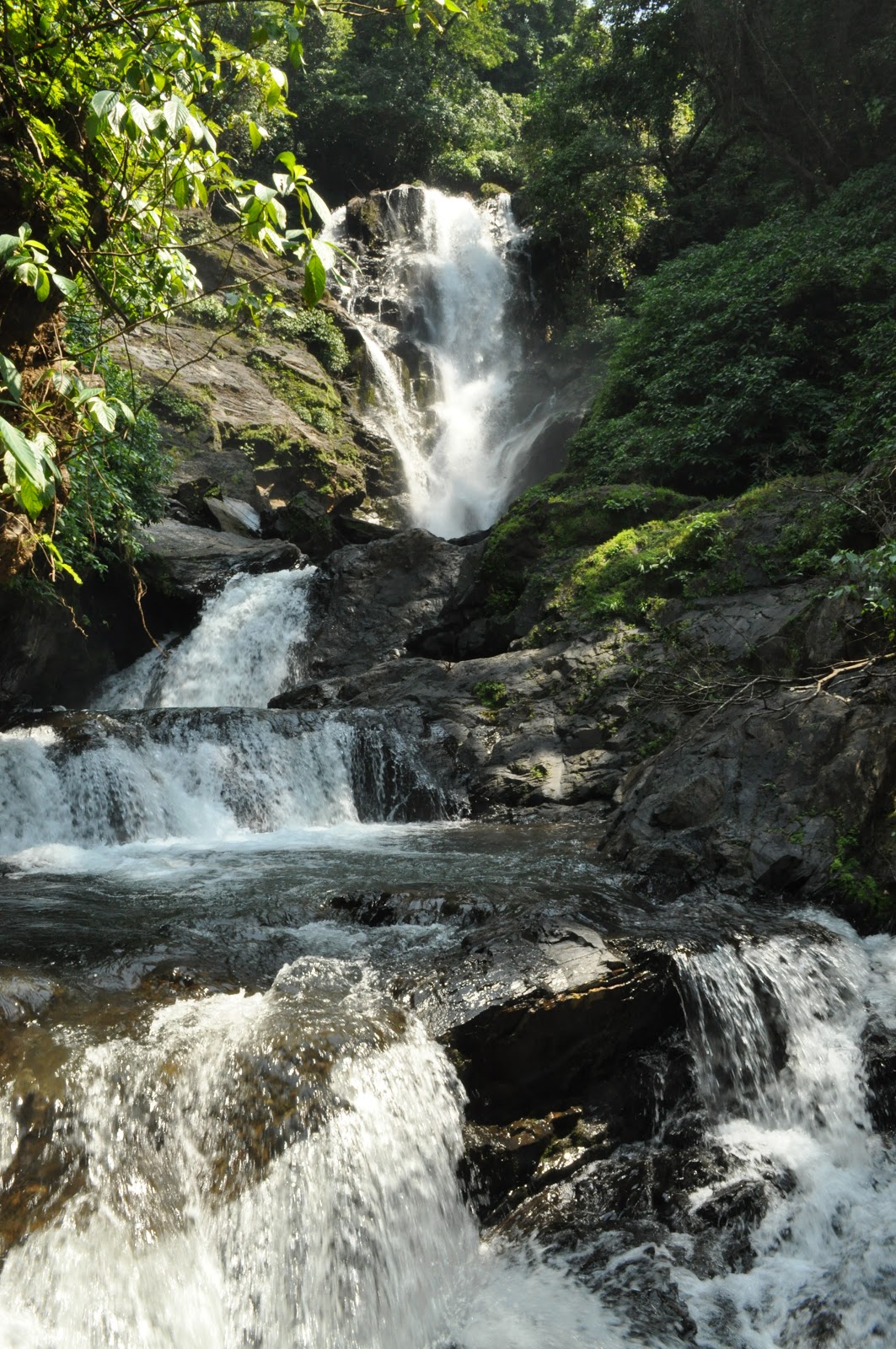
Viboothi Falls is a mere 8kms from Yana, but the winding and treacherous road makes it look longer than that. From the end of the motorable road it’s another 2 km walk to the waterfalls. Viboothi is as pristine as they come these days. Nestled in the Sahyadri Ranges and formed on River Gangavali, Viboothi gets its name from the limestone formations in the area. It is a 3-tier waterfall that forms a tiny pool, worthy of being called heavenly. The riverbed in this pool is haphazardly stuffed with big boulders, making it very perilous for the tourists. You have to be extremely stupid to dive into these waters. Unlike Sathodi, this is the kind of falls where you can relax, unwind, take a dip and refresh yourself in the pristine waters. It is an ideal picnic spot where you can spend a couple of hours playing in the waters and not know the time fly-by. Though Sirsi has many waterfalls, not all of them entertain the tourists to play in their laps. Viboothi is one such falls that embraces her visitors and leaves them wet, fresh and recharged. A must-visit waterfalls for your Sirsi itinerary.

Getting-there: 8kms from Yana.

Must-Do: Take a dip in the water and get totally refreshed and rejuvenated.
Must-Don’t: Diving into the pool and littering the place.

My Rating: 8/10

Tuesday, October 30, 2012

Sathodi Falls, Yellapur

This was my second attempt at getting to Sathodi Falls and yet again for a briefest of moments I felt my chances of getting to see this waterfall receding, just like the sun setting in the horizon. The first attempt was a failure because accessibility was an issue. After reaching Yellapur, I found that there were no buses that go to Sathodi Falls. I knew it wasn’t wise to hire a Jeep or a rickshaw as they would charge me buckets. I was told that youngsters there offered to take you to Sathodi for a nominal amount. As it turned out, the nominal amount was Rs. 400 – something that I was expecting the Rickshaw-wallas to demand. I decided to drop the plan and instead go to Magod Falls. But even that didn’t materialize since the bus timings were very erratic and less frequent.

But this time round I was travelling with a group and with our own transport – a Tavera. The threat to our chances was however from the receding daylight. Our first challenge was to enter the forest area before 6:30PM before the gates close. And the second was to spend enough time enjoying the view and yet get back to civilization before it’s too dark. Sathodi is a 28km drive through the forests from Yellapur town. The roads are in a bad shape for the first 23kms. For the last 5 kms there is simply no road. Ok.. Im exaggerating a bit here. There is indeed a mud road for the last 5 kms but it’s in a pathetic condition. The rains make the road even worse with loose soil and slippery slopes.

With the menacing road taking a toll on the vehicle and the eager-to-retire sun looming over our heads, we started questioning the rationale of going ahead with our plan. Would the destination be worth the journey? Would we be able to spend at least 10 minutes there? Even if we do, are those 10 minutes worth the trouble we took just getting here? What if we have a flat tyre on the way back? Is it safe to spend the night in this jungle? Just as all these questions were hovering around inside the confines of our heads, we got our first glimpse of the backwaters of Kodasalli Dam. And just like that, our apprehensions started disappearing. We were now more than eager to get to the waterfalls.

We finally reached the check-in point of the falls where we paid a nominal entrance fee and quickly made our way to the falls. A one kilometer walk later we gaped with open mouths at India’s little Niagara falls. I had to admit that the pictures you see of Sathodi in the internet do no justice to the real deal. Even though you don’t get to go near the foot of the falls, the view is pretty intimidating. While most waterfalls I’ve seen till date are tall, and single or multi-tiered, this one was w-i-d-e. And thanks to all that rain for the last couple of weeks, Sathodi was a decked-up princess. Anybody with half a brain would know better than to venture into the water. At this time of the year Sathodi was strictly a viewing-only waterfall. Even though we had set ourselves a deadline of 15 minutes to reach back to our vehicle, half an hour had already passed. Not completely content with the amount of time we spent here, we had to drag ourselves back to the car. Our apprehensions of a flat tyre were highly misplaced and we reached Yellapur, and subsequently Sirsi, incident-free.

Getting-there: Sirsi->Yellapur ->Sathodi (Follow the signboards at Yellapur)

Must-Do: Start early so as to spend enough time there and get back safely
Must-Don’t: Adventurism or heroism in the rapid waters.

My Rating: 8/10

Sahasralinga, Sirsi

The literal translation of Sahasralinga means a 1000 Lingas. And that’s precisely what you get to see here. On the banks of river Shalmala are carved hundreds and hundreds of Shivalingas and Nandis (Basavannas). It is believed that for every Linga, there is a Nandi staring at it. Currently there are far too fewer lingas, and even the ones present have suffered some damage over the years thanks to the force of the ravenous waters. Even then the sheer number of Lingas and Nandis is sight to be seen to be believed, notwithstanding the fact that we went there at a time when the water flow was high.

These Shiva lingas were built by King Sadashivaraya of Sirsi. It is best to visit Sahasralinga during the dry seasons, when the flow of water is pretty less. Sahasralinga is 10 kms from Sirsi. A recent addition to this tourist location is a hanging bridge built across the river to connect neighboring villages. Since the flow of water is comparatively gentler, this place can also double up as a picnic center. Children might enjoy play in the water here.

Getting-there: About 10 kms from Sirsi en route Yellapur.

Must-Do: Visit during the dry seasons to see more of the lingas surfacing.
Must-Don’t: Vandalism and Littering.

My Rating: 6/10

Sunday, May 27, 2012

Dudh Sagar Falls Trek, Karnataka - Goa

The ever-persistent chirping sound of crickets, the lazy croaking of the frogs, the early rising birds on the look-out for food and the steady sound of flowing water streams. It is not every day you wake up to such an assorted collection of sounds. I unzip the opening of the tent and calmly crawl my way out, to avoid waking the others. The sea of green and the milky water stream greet my eyes... and my senses. How I wish I could get a hot cuppa coffee now. Just as I try to evade thoughts of greed from my head my attention is diverted to a troop of monkeys who are making their way towards our camp. They look for food for themselves and their little ones. While the elders are busy raiding all the plastic covers and trash left behind by some mindless tourists, the young ones entertain themselves by flinging from one tree to another and playing rat-and-mouse game. Once the elders are satisfied there are no more food to be hoarded, the troop continue to their next destination.
Just as I begin to convince myself that I’m indeed in heaven, along chugs a 126 tonne, 4000 hp turbocharged, V16 cylinder mean machine to shatter the morning calm. This WDG4 diesel-electric engineering marvel with a top speed of 120kmph pours cold water (or must I say hot steam) on my morning musings. A total of 5 WDG4 engines are required to take the nearly 100-odd goods bogies through Braganza Ghat section. The blaring noise and the heat generated from the train passing barely couple of meters from our tents hardly woke anyone. This could be attributed to fact that most of the troop members were by now immune to the noise by now. The extensive physical activity of walking on the uneven surface of the Railway line was another cause for this lethargy.
My mind couldn't but wander to the previous day. But after much dilly-dallying there were 9 of us who set off from Bangalore to a larger-than-life image of the majestic Dudh Sagar Falls. Timing, logistics, planning and execution for this trip were crucial and thankfully for us, it was spot-on. Train booking at the eleventh hour, buying an extra tent, buying and distributing ready-to-cook MTR packets, eatables and water bottles were all planned and executed exactly as planned. After getting off Rani Chennamma at Hubli Junction we first booked tickets to Castle Rock station in the Unreserved compartment. With one more hour before we can catch our next train (Chennai-Vasco) we had a sumptuous breakfast at the Railway canteen. As expected we made an experience out of travelling in a General compartment after all these years - for couple of them it was their virgin train journey!
After getting down at Castle Rock Station we re-packed our bags by distributing the MTR Read-to-cooks, so that the weight each of us carried was not skewed. After a customary photo at the station we started off along the tracks on our 14km long trek. This was our first Railway trek and it posed its own little challenges. Now even though the surface is not uphill, it can still be a minor inconvenience considering all the gravel and of course human waste. It takes a a while to get used to walking on the planks especially since you have to take short steps all the while avoiding gravel and human waste. Initially you forget to watch the landscapes as you are busy watching the track, but as you make progress the visuals on offer are too hard to resist. Your feet start to strike the right rhythm and your eyes start to wander. The thick vegetation mostly covers the views that Braganza Ghat has to offer. But when it reveals itself, it’s a sight to behold. Even the 9 year old lion-heart in our group takes a minute or two appreciating nature, before he gets going leaving the others behind.
And then there are the tunnels. One after the other and one bigger and darker than the other, with the longest being half a kilometer. And if you get caught in a tunnel with the train passing, that’s an experience of a lifetime. Not only is it a good photo-op but also a hair-raising experience - literally. The heat and noise generated by the engines is so high, it can send shivers down your spine. By the time the train passes you, you would have turned two shades darker and suffer from momentary deafness.
After a lot walking which included a long haul at a mini waterfall, we finally reached the halfway mark - Caranzol Station. Always a group to start a conversation with the locals, we found out from the station master that there would be a Goods train arriving anytime now and heading towards Dudhsagar. The good station master advised us to take the goods train to Dudhsagar and spend some quality time at the Falls rather than walking on the tracks. Apparently they find nothing amusing about walking on the tracks. After a quick group huddle we decided to take the goods train after all, which later turned out as a blessing in disguise. Within no time the goods train arrived at Caranzol and with the station master having a word with the Guard in the train, we bundled ourselves into the Guard's compartment. And thus started the group's first Goods train ride of our lives. With no ticket counters at any of these stations, we got ourselves a free ride to Dudhsagar after cleverly wriggling out of paying the Guard. The waterfalls is another 1km walk from the station. As always, even before we could see the falls, we could hear it. And this always heightens the excitement. We made a dash to the final stretch and Voila! Nothing much has changed about Dudhsagar in the last 18 years since I last saw it in a school trip. Since it wasn't monsoons yet, there wasn't much water - but just enough to have a great time at the base of the falls.
The walk to the base of the falls is very challenging. The rough and uneven terrain can squeeze every ounce of your strength. But the result is much more rewarding that the effort put-in. The view from the base of the Falls is wholly different sight. It looks majestic to say the least. Even the little oasis formed at the point where the water finally reaches ground zero looks straight out of a movie scene. No sooner than we set our first tent, did a forest official come and informed us that we cannot camp here for the night as there will be an inspection by some senior officials. Disappointed by this we had to go back up to the railway track where there is a provision to camp for the night. After the demanding climb back, we immediately set up our tents there and started a campfire and cooked our MTRs. And then one by one crawled into our respective tents and sleeping bags for a good night's sleep.
I was woken out of my reverie by a second troop of monkeys who came looking for food. This batch was much more daring and adventurous than the earlier troop. By this time everyone was up and we had a hard time keeping the monkeys away from getting to our belongings. But they too eventually left and we cooked some soup packets for breakfast. We then lazed around all morning and headed back to Dudhsagar station around noon. And then another first in our lives. After much pleading with the drivers we got a once in a lifetime opportunity to ride in a WDG4 diesel electric engine. The train took us till Castle Rock after which we took another goods train to Londa in the Guard's room.

With time to kill we filled our stomachs with Vada Pavs and hearts with talks that ranged a variety of topics. With friends like these there's never a dull moment. By the time Rani Chennama rolled out of Londa we were already starting to dread the hectic life of Bangalore - the only comforting factor being that we will be re-united with our loved ones. Thank God for such little happiness....


Getting-there: From Bangalore, trains are the best option. Hubli or Londa are the major stations near to Braganza Ghat Section. If you wish to trek, Castle Rock is where you start. It’s a 14 km trek to Dudhsagar.

Must-Do: Railway Trekking is fun and different. Get to the base of the falls if there isn't much water. Camp near the falls.

Must-Don't: Littering and troubling the monkeys (remember we are intruding their territory)

Other Attractions - Ancient Thambi Surla Temple and Tambi Surla Falls (From Dudhsagar go to Kullem and then to Mullem)


My Rating: 7/10

Thursday, March 22, 2012

Kambala at Jappina Mogaru, Mangalore

Traditions - The passing down of elements of a culture from generation to generation, especially by oral communication. We Indians are no stranger to them. In fact, everything we do is bound to traditions in some obscure way or the other. Even our daily chores are one way or the other related to some tradition. And then there's the kind of tradition that is specific to a region or a culture or mythological significance. Over time these traditions or public spectacles either fizzle out and get relegated to obscure pages of history or emerge to become gala events owing to commercial viability. Then there are a few that stand the test of times for its pure entertainment factor.

Kambalas' held in the coastal regions of Mangalore a.k.a Tulu Nadu walk a tight rope between tradition and entertainment. It is still one of Karnataka's best kept secrets compared to its more illustrious cousins - Bull Taming at Jallikattu and Bull Race at Ongole. Kambala has the simplest rules. Each team has 3 team members - a pair of bulls and a six-pack yielding Indianized Usain Bolt. And the simple rule is to get from point A to point B with all team members in tow till the finishing line. It's always a race between two teams. The last standing pair is the winner.

There are many Kambalas held across the coastal region starting from November and extending until March. Different regions have their own significance and history and celebrations surrounding the event. We chose to attend Jappina Mogaru (in Mangalore) for no apparent reason other than just sheer convenient timing. Our reliable sources suggested that we visit Jappina Mogaru the day before the main event, for this day provides the perfect photo op of the raging bulls practicing before the Grand Finale. As it turns out, it was indeed a good decision. The number of people attending the event was comparatively fewer, which provided us with front row seats to freeze the action into pixels.

Much like F1 racing, it all begins with the "team" walking the length of the track to get a feel of the slush course. This is followed by a dry run without much fanfare. Once all the teams get a first hand account of the track they comeback for a second try. Some even come for a third run and on this occasion, mostly alongside a competitor to size-up their opponents. But even through all these test runs you can feel the excitement building among the local spectators who have already turned up in decent numbers. Right on cue from the commentator, scores of heads crane out to catch the action. Heart beat rises when the team makes their way past them and then the crescendo drops when the racer lets go of the now-uncontrollable bulls at the finish line. And immediately there's a murmur of approving or disapproving syllables.
Walking away from the races there's plenty of other attractions for the wandering soul. The Kambala serves as a small village fair. You will find many stalls serving farm-fresh Watermelons, Pineapples and assorted fruit bowls. There are also the typical try-your-luck games and Ice-gola vendors. Incidentally the race track sits on the banks of the picturesque Netravathi River overlooking the famous Bridge.

I also wandered towards where all the action begins. The start point of the race. And here is where my perspective of the race started changing. Earlier in day, when I watched the Bulls dash to the finish line with the racer in tow, it looked clear that there needed to be perfect harmony between the human and the creatures, much like a horse and the jockey. Unless there's a perfect understanding between the two, the chances of them winning were slim. All that changed when I saw the animals getting whipped for no apparent reason than get them enraged and ready to charge down the track. The excessive whipping can melt the hearts of the weak but not the men who control them. Agreed the bulls have a thick skin, but you cannot overlook the sight of them wincing in pain after every whipping. Then there were those creatures that were unable to stand on their feet and kept falling at the start line. We did see instances of these bulls being prohibited from sitting down in the tents, just so that they won’t slack off in the race.

And that was the cue for me to leave the place. I could not take it any longer. I feel for these animals, and just hope that this tradition continues without so much as getting the bad treatment for these poor creatures. Overall, it was a great experience to be part of a great traditional event.


Getting-there: Mangalore has a good network of private buses. As for directions from the locals (and bus drivers and conductors) for Jappina Mogaru and they will be more than happy to help. Real warm and helpful people.

Must-Do: If you a photography enthusiast be there the day before the event and get a good spot to capture all the action.
Must-Don't: Avoid getting into trouble with the authorities (inside joke :) ) and getting in the way of the Raging Bulls.

My Rating: 7/10

Monday, November 21, 2011

Kuruva Dweep (Island), Wayanad

Continued from here and here.

Kuruva Dweep is a group of islands formed by River Kabini. It is also the most visited place in Wayanad. Kuruva Dweep is a good recreational place. The boulder-infested river is a good place to wet your feet and splash water around. It can be a good picnic spot to spend a lazy afternoon. Be warned that in flow of water in certain parts can be intimidating. The huge boulders though can break the flow can still be dangerous if one falls on it.

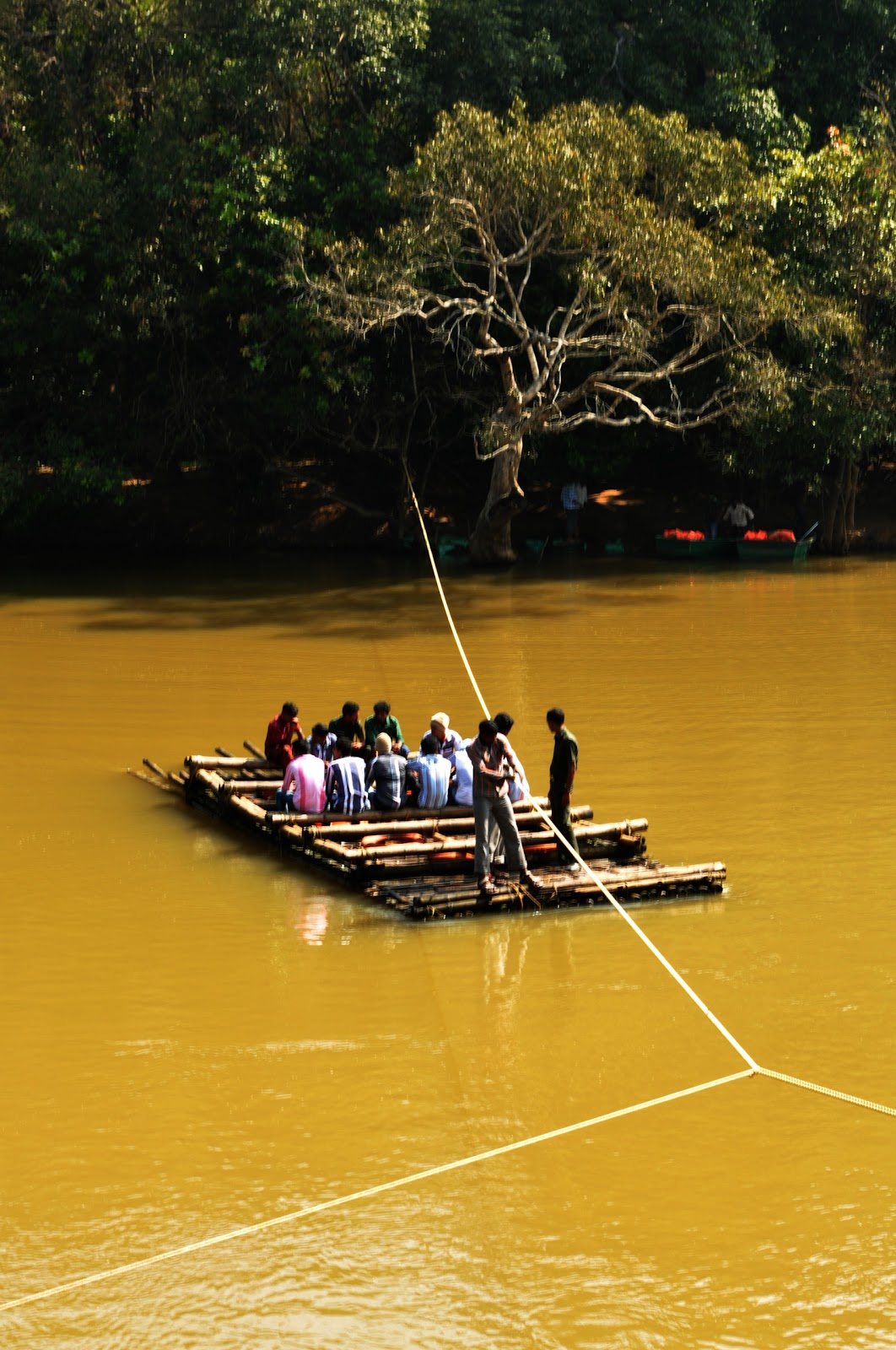
But getting to this place is not so easy. There’s quite a lot of walking to do and a handsome price to pay. Right where your vehicle is parked, there’s an entry fees to catch a raft that will take you to the other end of the river. Personally travelling in a raft has been my first experience. What I did not expect was a rope tied from one end of the river to the other. And the navigation of this raft was done with the help of this raft, by pulling them and even taking a 360 degree turn. After crossing the river one needs to walk half a kilometer before you will be asked to pay for another entry fee, plus additional charges for camera. I really don’t understand the idea behind paying entry fees twice. But that’s the way it is. Thankfully the place is not all that trashed, meaning that money goes in the upkeep of the place and also as wages to the many men and women posted in Army overalls.

It’s another couple of kilometers before you get a chance to wet your feet and play in the water. But once you get there, it’s all fun and games if you are coming as a group. Make sure you spare at least 2-3 hours for this location when you plan your trip.


Getting-there: 23kms north of Kalpetta.

Must-Do: Spare enough time to have fun. Exercise caution.
Must-Don’t: Littering.

My Rating: 5/10

Monday, November 07, 2011

Srirangapatnam, Mysore.

Jamia Masjid
As mentioned here, Srirangapatnam deserves a separate mention or two. Being Tippu Sultan’s capital the landscape here is dotted with monuments in connection to this great ruler of South India. One of the first monuments you’ll notice once you enter Tippu-land is the Jamia Masjid. Built in 1787 A.D., the mosque has two Octagonal minarets. A few meters down the road and one can find the place where Tippu’s martyred body was found. There’s a commemorative stone placed here, in memory of the King who stood against the mighty British.


Col Bailey's Dungeon

A kilometer ahead is the Colonel Bailey’s Dungeon. If you thought Colonel Bailey used this dungeon to imprison Tippu’s soldiers, then you are wrong (as was I). The dungeon is so named because this was where Col. Bailey died while being a prisoner of Tippu. This dungeon also housed other prominent British figures like General Baird and Colonel Brithwite among others. Apparently prisoners were chained to the walls in a standing position and dungeon flooded with cold water till waist height. Quite ironically there’s a canon bang in the middle of this dungeon. Legend has it that the canon fell through the roof while it was being used against the British. There’s still a gaping hole in the ceiling, which is testimony to this theory.


Daria Daulat Bagh
 Daria Daulat Bagh (Tippu’s Summer Palace): You cannot come to Srirangapatnam and not visit Daria Daulat Bagh. Even though this is Tippu’s summer palace, it is more of a garden than a palace, as the name suggests. This summer palace of Tippu is nestled in thick green cover and lush carpet of grass. And keeping with the color all around, the palace is painted green. The exterior painting of the palace is just an example of the things to come inside. It wouldn’t be unfair to state that, not an inch of the walls and the ceilings have not been touch upon with a brush. And this is not just a coat of paint. Every wall and ceiling is adorned with paintings of the Tippu’s armies and gardens and flowers and random patterns. The palace is now converted into a museum containing artifacts and paintings – both by locals and Britishers.
The garden here double up as playground for kids who are bound to have a gala time. Must-visit place if you are in Srirangapatnam.

Nimishamba Temple
Next up – Nimishamba Temple. Well, this temple has hardly got anything to do with Tippu and his kingdom. But it was in the heartland of Tippu and on the way to Gol Gumbaz. Hence we stopped by. This timple is situated in the banks of River Cauvery and about 1km from Daria Daulat Bagh on the way to Gol Gumbaz. Now, here’s why you must visit Nimishamba. It is believed that Nimishamba (re-incarnation of Goddess Parvathi) removes all obstacles in your life within a minute and hence the name (Nimisha = Minute in Kannada). It is also believed that whatever you pray for here will be granted. So who doesn’t want to visit here? Let me also mention why you might want to skip this temple. Well for starters, this looks like an average Indian temple. Nothing spectacular in the architecture or the atmosphere. If you are lucky you may get a “darshanam” in half hour. Also watch out for the crows who replace the monkeys as the traditional bullies at sought-after picnic spots. These skilled crows can grab food from right out of your hand while you were contemplating on less important matters like hike in petrol prices.


Gol Gumbaz
 Gol Gumbaz – A fascinating name for a not so impressive tomb. I say this in comparison with the Qutub Shahi tombs of Hyderabad. There’s a single tomb which has the remains of Tippu Sultan and his parents. The complex also houses tombs of various other relatives of the king. By this time the Sun was out and doing a good job at sapping out energies. Considering that we still had to complete our next leg of our tour - Mysore Palace (a.k.a Amba Vilas), a much needed revitalization was in order. The women indulged in some shopping to regain their energy while I hydrated myself sitting in the air-conditioned confines of the car, before hitting the road again.

Getting-there: 130kms from Bangalore. 20kms before Mysore.
Must-Do: Have plenty of time on your hands to have a leisure trip.
Must-Don't: Vandalism.

My Rating: 5/10

Tuesday, May 31, 2011

Mookambika Temple, Kollur

If you are a Hindu Malayali, the chances of you visiting the Mookambika Devi Temple at least once in your lifetime are pretty high. The temple may geographically lie in Kollur, Karnataka, but you will easily mistake it to be somewhere in the lush green mystic mountains of Kerala. The chances of hearing Kannada voices here are as remote as the sun setting in the east.
The presiding deity here is Goddess Mookambika, believed to be the manifestation of Shakti, Saraswathi and Mahalakshmi. This temple is also considered to be one among the Seven Muktisthala pilgrim centers in Karanataka along with Udupi, Subramanya, Kumbashi, Koteshwara, Sankaranarayana and Gokarna. Another significance of this temple is that Sage Adi Shankaracharya is believed to have perceived the idea of setting the temple here by installing the idol himself, some 1200 years ago.
The temple is situated at the foot of the Kodachadri Hills and on the banks of River Sauparnika. If you have a day to kill, you can consider a trek to Kodachadri peak. There are all-weather Jeeps that take you to the peak. We however kept this trek for a later date.
The Mookambika Devi is also a favourite for Vidyaramba. A lot of small kids are initiated into education  here by writing in a platter of rice. The temple can get really crowded in the mornings and late evenings, as there is a steady influx of devotees. So you might want to go during the "non-peak" hours.

Getting-there: 60kms from Murudeshwar. 420 kms from Bangalore. Buses are available from both locations to Kollur.

Must-Do: There's a clothes regulation here. You cannot enter the shrine wearing, shorts or three-fourths. Men have to be bare-chested.

My Rating: 6/10

Friday, May 27, 2011

Apsarakonda Falls, Honavar.


After reaching the far end of the beach, we started walking in-land and soon enough we found human habitation there. We started asking around, and thankfully realised that we were on the right track. The Apsarakonda was a mere kilometer walk from there. And yes, we didn't have to climb the hillock. 

The Apsarakonda hardly qualifies to be called a "Waterfall". If you are rich, you can probably create one in your own backyard. There's a steady stream of water pouring down a well-shaped earth-pit with some phantomesque setting. But the fresh water was enticing enough to make me go take a dip. Parched from energy-sagging walk, I drank the fresh water to my heart's content. And suddenly all the fatigue and the exhaustion disappeared. I was now ready to head back to our hotel in Murudeshwar.

Getting-there: The best way to the reach here is to take a Rickshaw from the Honavar-Murudeshwar road. The other way of course is from the beach - not recommended if you are not a regular walker in the sun.


My Rating: 4/10

Wednesday, February 23, 2011

Hampi, Day I


Vittala Temple
 Day I Highlights:


Vittala Temple: Now this is a “must-see” when you are in Hampi. And this is where the famous Stone Chariot is located. We always engaged a Guide in such places to show us around. But with the on-going Hampi Festivals, none of the ASI guides were around. Apparently they were taking care of arrangements for the festival. But having struck a conversation with a “slightly off-guard” guard, if you know what I mean, he was ready to show us around for a few bucks. Well, we had nothing to loose, it was either way better than having no guide at all.


Stone Chariot at Vittala Temple

In the end the guard turned out to be alright, despite his wavering speech. He also helped us hear some sounds from the hollow musical pillars. The main temple complex with the musical pillars was however out-of-bounds for tourists owing to renovation work. The other star attraction at the Vittala temple is the Stone Chariot. This monolith Stone Chariot is exquisitely carved and speaks volumes of the great Indian craftsmanship.
Japanese style architecture

Achyutaraya Temple and Matanga Hill: Achyutaraya Temple is a desolate and abandoned temple situated next to Matanga Hill. I feel it’s mandatory that you climb Matanga Hill if you visit Hampi. You would get a bird’s eye view of Hampi, it’s surrounding villages and millions of rock formations as far as the eye can see. Apparently this Hill offers the best sunset on view, but it was way too early for us to wait for the sun to set. Bottom line – do not miss it.

Anjeyanadri Hill: Another must-see location in Hampi. Why? Because this hill is believed to be the birthplace of Lord Hanuman. Getting there is a little tedious. You first need to cross the river Tungabhadra on a coracle (about Rs 50 per head), then walk some 4 kms to reach the foot of the hill and then climb some 600 odd (or more) steps. But if you have money to splurge, then you can take a longer coracle ride and reach a kilometer near the foot of the Hill. But then it’s all worth the effort considering the tranquility and significance of the location. From atop the hill there are 3 views on display – rocks, ruins and greenery. If you have the time, you might also want to check out Lord Sugriva’s hiding place, some 3 kms from here.

There are umpteen other ruins and structures that you’ll find along the way. But I’ll leave it to you to explore them. Also, if you are an Athletic person, you can cover all these places on foot with a coracle ride pitched-in for Anjaneyadri Hill. 


Precautions:
  • Carry enough Sunscreen lotions and water bottles, since it is extremely hot and dry.
  • The best time of the year to visit would be November, which is also the usual time of the Hampi Festival.
  • To see the mentioned places in this blog, you need not hire a bicycle, since the terrain is difficult and it's easier to just walk.
  • If walking is not an option for you, you can hire a Taxi or a Autorickshaw.
  • it's better to coincide your visit with Hampi Festival, but be aware of the mildly uncivilized local population.

My Rating: 8/10

Tuesday, February 22, 2011

Hampi, Hospet

2010 has been a mixed year for us in terms of travelling. Though we didn’t see too many new places, whatever we saw more than made-up for what we didn’t. The year began on a promising note with Goa. This was also the year we discovered the glory of Hoysala Kingdom. The temples of Halebeedu and Belur set us on a Hoysala Trail. The architectural splendor of ancient India had a cascading effect and we started exploring other historical places like Badami and a few other Hoysala temples. Another first that I managed to achieve was the famous Snake Boat Races of Kerala – Aranmula Boat Race. Having been to the beaches, famous temples and the like we decided to head to the hills. And we chose, probably the best hill station in south India – Chikmagalur, to complete a satisfying year for travelling.


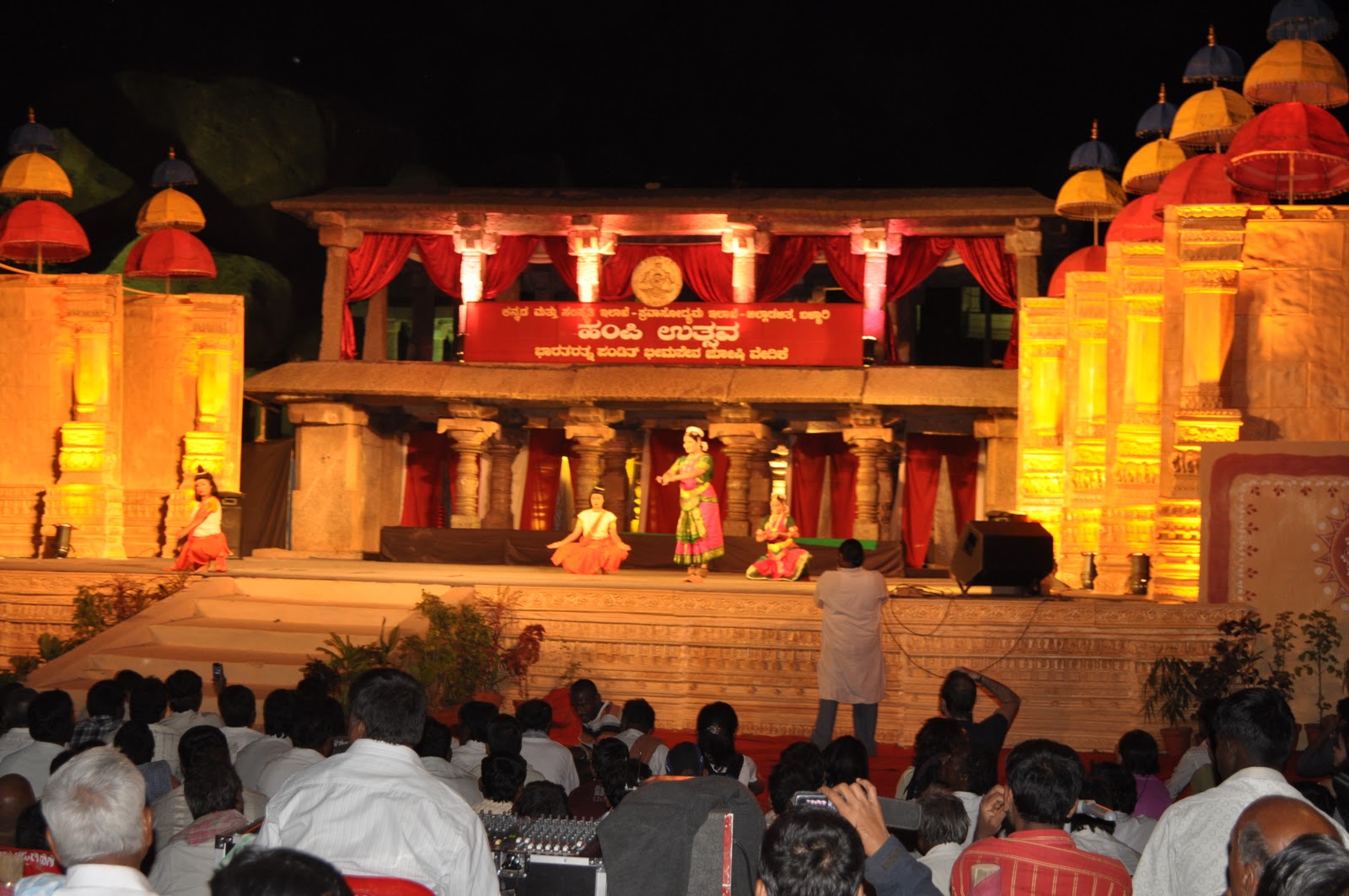
2011 promises to be a good year too. And we decided to kick-start it with a prominent destination. Well, to be more honest, we didn’t really plan it that way. It was almost an impromptu plan. The deciding factor was an Ad in the papers announcing the Hampi Festival. Usually, the Hampi Festival happens during November of every year. But this time round it was moved to January to coincide with the 500th year of the coronation of Emperor Krishnadevaraya of Vijayanagara kindgdom.

An overnight train from Bangalore will bring you to Hospet, the nearest railway station to Hampi, 13 kms away. Now Hampi is world-famous tourist destination, and like every popular tourist place in India, people will try to trick at the drop of a hat. Hampi is no exception. There are many options reach Hampi from Hospet. You could take a taxi, Autorickshaw, shared 7-seater autorickshaw or bus. Depending on the size of your wallet, you can choose your ride. The Autorickshaws cost a whopping Rs 100-125, whereas the shared 7-seater rickshaw costs a mere Rs.15.

Accommodations in Hampi is nothing spectacular to talk about. There are a handful of houses-turned-guesthouses that takes care of accommodating the tourists. You cannot but wonder that these guesthouses are overpriced, especially what with the Hampi Festival shooting prices through the roof. We paid Rs 750 for a lousy room in Santhosh Guesthouse, which according to a banner is recommended by “Lovely” Planet. But their roof-top restaurant is probably the best in this sleepy town. All guesthouses/ shops/ restaurants are located in a single street leading to the Virupaksha Temple. There are however good hotels in Hospet, if you want to stay comfortably.

We spent two days in Hampi and that’s how I’ll classify the blogs here that way: Day I and Day II.

Day I started with us renting a bicycle for Rs 50 a day which in hindsight was a complete waste of money for that day. We went about exploring the Tungabhadra side of Hampi. On this side of Virupaksha the major attraction is the Vittala Temple, the King’s Balance, the Pushkarni, the Achyutaraya Temple, Matanga Hill, Hemakunta Complex, Lakshmi Narasimha Temple and the Anjeyanadri Hill among others. Well, the list doesn’t end there but those are what we could cover! And yes, if you are a budget traveler you can cover all this on foot/coracle.


Day II we covered Virupaksha Temple, Krishna Temple, Underground Temple, the Noblemen’s quarters, Royal Enclosures, Zanana Enclosure, Lotus Mahal, Elephant Stables, Mahanavmi Dibba, Hazara Rama Temple and the Stepped Tank. Hiring a bicycle or moped is an absolute necessity here.

Words of Caution:


  • It’s extremely hot in Hampi. Make sure you keep yourself hydrated. Do not miss an opportunity to buy water bottles wherever available.
  • There are way too many kids on the street begging for alms. Do not encourage them.
  • Foreigners should try to avoid the locals as much as possible. They can get a little “probing” if you encourage them.
  • Negotiate with all vendors before doling out money.

Sunday, November 14, 2010

Kalahatti Falls, Chikmagalur.

After a dose of history and - in the words of a funny panda - sheer awesomeness at Armruteswara temple the previous evening, we were ready for our primary objective of coming to Chikmagalur. The hills, streams, waterfalls and mist all beckoned and we answered by hiring a cab and deciding to make a day out of it. First stop according to our over-enthusiastic cabbie was Kalahatti a.ka. Kallathigiri a.k.a Kalahasthi falls near Kemmangundi.

The most interesting and striking feature of Kalahatti Falls is that it flows through, over and between an ancient temple of Veerabhadreshwara believed to be built during the Vijayanagara empire. Also, legend has it that sage Agastya had performed penance here. The entrance of the temple has carvings of elephants, over which the water cascades. The water flowing through here is believed to cure illnesses if one takes a dip. But we Indians being what we are, come with bathing soaps, shampoo packets and all the paraphernalia to have a full-fledged bath.
Despite the freezing cold temperature of the water, we felt extremely temped to get wet. And finally we yielded to the temptation by getting under the powerful downpour. Such was the force of the water beating down on my back that I pulled a muscle. To top it all the uneven stony ground makes it hard to balance yourself against the onslaught.

One could also climb one tier up to witness another mini waterfall. The crystal clear water is difficult to be given a pass for a quick dip. Here you need to tread carefully, since we found quite a lot of broken glass bottles. This is the result of uncivilized burden-on-Mother-Earth creatures resorting to drinking and discarding bottles unsafely. Once we had all the fun, we decided to go back our cab. Quite honestly it’s not really the kind of place where one would want to spend a lot of time. The fun wears out after an hour or so….

Getting-there: You either need to have your own car or hire one. It’s on the way to the hill station of Kemmangundi.

Must-Do: No matter how freezing the water – take a dip!
Must-Don’t: Drinking and littering the place with bottles, shampoo and soap packets, pooja paraphernalia, plastic bottles etc.

My Rating: 6/10

Saturday, September 04, 2010

Aranmula Boat Race, Chengannur.

It feels like an eternity since I put on my travelling boots and when I eventually did, I realized I just struck-out one item from my places-to-be-before-I-die list. Kerala has always been close to my heart, not just for its beauty but also for it being my native land. So, it’s natural that everything about Kerala fascinates and excites me. But there are some things that excite any person irrespective of where you come from.

The annual boat races of Kerala is one such event that you would go any lengths to witness. So despite quite a few glitches, I was determined to experience it. And thankfully so, my determination paid of. A hurriedly arranged trip which involved getting stuck in Bangalore traffic for a good 2 hours before I ran on the wet and slippery platform of Yeshvantpur Railway station with two bags cumulatively weighing at least half my weight finally saw me witnessing the Aranmula Boat Race from the steps of Parthasaradhi Temple in Aranmula, Chengannur.

The Aranmula boat race is one among several annual boat races that live under the shadow of the more popular Nehru Boat Race. But unlike the tourist-oriented Nehru boat race, the Aranmula boat race is more a tradition than a competition and the oldest amongst the lot. The race coincides with the last day of Onam on which day the commemoration of the installation of the deity Lord Krishna is done. River Pamba on whose bank the temple resides is where all the action unfolds. The Chundan Vallam (Snake boat) is approximately 103 feet in length and have about 4 helmsman, 100 rowers and 25 singers.

The Vallamkali (boat race) have two categories. The first, where the Palliyodams (snake boats) from different villages of the surrounding areas compete against each other. The main singer leads the team with a vanjipaatu (boat song). The Oarsmen row the boat following the tune and rhythm of the singers. The first part of the competition is not a race, but rather a competition to decide the most synchronous and well sung team. After that comes the boat race to decide the fastest of them all.

Needless to say, it’s a real treat to the eyes watching these men in action. It’s unlike any sport in the world. It also happens to be the sport with the largest team size. The whole event takes about 3 hours to complete and at the end of it, you will be hungry for more. At the end of the race is the famous Valla Sadya (feast) to satiate your physical hunger. The whole charged-up atmosphere, the constant rhythmic vanjipaatu in the background, the lingering aroma of Valla Sadya and holiness of the temple makes it a trip that is truly unforgettable.

Getting-there: It’s a half hour bus ride from Changannur railway station. When in doubt, just follow the crowd.

Must-Do: Witness the boat race, take a boat ride and get a closer look at the Snake boats before the start of the race, eat the Valla Sadya, record a live vanjipaatu of a team.

Must-Don’t: Littering.

Other Attractions: Buy Aranmula Kannadi – metal mirrors. Aranmula Kottaram (palaces).

My Rating: 8.5/10