Showing posts with label Hoysala Trail. Show all posts

Wednesday, January 16, 2013

Cheluvanarayana Temple, Melukote

Melukote has been on my travel bucket for long. But as luck would have it, while I finally made it to Melukote, it wasn’t a totally fruitful trip. This was the longest road trip for our 11-month old and as it turns out – the most difficult. It was extremely difficult to keep leash on our hyper-active and restless little angel. She can be quite a handful in such occasions and that takes a toll on her mother too who was all but drained-out by the time we reached Melukote. My mother-in-law is another person who can’t undertake long road trips even if the end result is visiting a famous temple. As a result when we reached Melukote, we visited the Cheluvanarayana Swamy Temple and returned back to Bangalore. The idea of climbing some 200-odd flight of stairs uphill to visit the Yoga Narasimha Temple did not find appealing enough for my wife and mother-in-law after such a long journey.

The Cheluvanarayana Swamy Temple is built on the foothills of Yadugiri and is situated about 145 kms from Bangalore and about 50 kms from Mysore. The temple is dedicated to Thirunarayana or Cheluva Narayana. On the top of the hill there is a temple for Yoga Narasimha. There is also a beautiful stepped tank at the base of the hill. It believed that the famous Srivaishnava Saint Ramanujacharya resided here for about 12 years in the 12th Century, thus making it a prominent place for Srivaishnava Sect and also home to the Academy of Sanskrit Research.

The exact year of construction of the temple is not known. But it is believed to have existed even before Ramanujacharya retrieved the lost metallic image of the presiding deity. It is also believed that Ramanujacharya using his influence and stature was instrumental in rebuilding and renovating the temple. Hoysala King Vishnuvardhana who was a follower of Ramanujacharya had taken refuge here for a brief period during the Muslim invasion of Dwarasamudra. Glimpses of Hoysala art are also very evident here. But it is not nearly as magnificent as any of the full-fledged Hoysala temples in the area.

For those who enjoy long drives, this is a good place to drive down to. The final stretch of 32 kms after exiting the Bangalore-Mysore road is also pretty good for most part. There are some winding stretches of well-carpeted roads when you can glide at 100 kmph. The village atmosphere, green paddy fields and the fresh air make the drive even more pleasurable.

Getting-there: Take right after Mandya town and follow the road for some 30-odd kilometers.

Must-Do: Visit both temples (Cheluvanarayana and Yoga Narasimha) and the Stepped Tanks
Must-Don't: Littering and Vandalism.

My Rating: 5/10

Wednesday, November 14, 2012

Boga Nandeeshwara Temple, Bangalore

Strange are the ways of the world. There are some things that I just don’t comprehend. That every Bangalorean has been to or knows about Nandi Hills is a common knowledge. But ask them about Boga Nandeeshwara Temple and they will draw a blank. What’s the connection? Well, the Boga Nandeeshwara temple is situated right under the nose of Nandi Hills. What makes the matter even more intriguing is that this is no ordinary run-of-the-mill temple. This temple was originally built in the 9th Century by Bana Queen Ratnavali. This temple was then expanded and renovated by the dynasties of Gangas, Cholas, Hoysalas, Pallavas and finally the Vijayanagaras. This is also quite easily one of the largest temples in and around Bangalore. Despite all this, the Boga Nandeeshwara temple is off the tourist map for reasons unknown. Also the Karnataka tourism boards that usually display even the slightest place of tourism interest have conspicuously missed out on Boga Nandeeshwara temple. That could be one reason why so few people know about (and visit) this temple – which is good in way because this temple so far has been well maintained with sprawling lawns, well-kept structures and even clean bathrooms!

The Boga Nandeeshwara Temple houses three different temples namely, the Arunachaleshwara, Uma Maheshwara and finally the Boga Nandeeshwara temples. They all together represent three stages of Lord Shiva’s life – Arunachaleshwara depicts Shiva’s youthful life, Uma Maheshwara depicts Shiva’s wedding with Parvathi and Yoga Narashimha depicts Shiva’s renunciation stage.

To the trained eye it is easy to make out the architectural styles of Gangas, Hoysalas and the Vijayanagaras. The many stone pillars in the temple reminds its devotees of the temples of Hampi – rich in stone artwork. The also houses a Mahanavami Dibba and a stepped tank called Shringi Theertha a lot like the ones we saw in Hampi. The temple also has a few soapstone sculptures which leaves a Hoysala signature in the temple. The highlight of the temple, in my opinion, is however the Shringi  Theertha (a stepped tank). This pond is believed to be created by Nandi by plunging its horns into the earth to draw water from holy Ganga. We spent at least an hour in the serenity and peacefulness offered by this magical place (but for the annoying “caretaker” who came asking for money every 10 minutes for no reason, which we obviously didn’t oblige).
In the end it was hard to bid goodbye to this temple but then we knew we would come back soon enough.

Getting-there: Cross Devanahalli airport and the take the left which goes to Nandi Hills. This road ends in a T-junction where left goes to Nandi Hills. Take the right here and travel 5 kms.

Must-Do: Check out the Stepped Tank and the stone carvings around the temple.
Must-Don’t: Vandalism and Littering.

My Rating: 8/10

Monday, October 29, 2012

Madhukeshwara Temple, Banavasi, Sirsi

Long before colonial Bangalore was deemed the capital of Karnataka, there was a lesser known capital for the state, which goes by the name of Banavasi. Set up in the 9th Century AD by the Kadamba dynasty, Banavasi was known to be the earliest known capital of Karnataka. As with most dynasties of that era, the kingdom revolves around the main temple in area. Madhukeshwara Temple occupies that significant stature in this regard. So prominent was Banvasi and the Madhukeshava temple that the temple originally built by Kadambas were renovated/extended by Chalukyas and the Hoysalas. As a result one can easily notice the different architectural styles starting from the garba griha to the mantapas. And yet there is no denying the fact that the mastery of the Hoysala craftsmen shine through. Hoysala craftsmen are top-of-the-class pioneers in stone craftsmanship. And their style is so distinct and uniform you can identify it pretty easily. The famous Hoysala artisan Jakkanacharya is being credited for the Hoysala additions. Im really beginning to doubt the existence of this character called Jakkanacharya. He’s been being associated with every Hoysala Temple dotted across the state. So unless he’s a superhuman sent from outer space, it’s highly unlikely that he would have worked with each of these temples

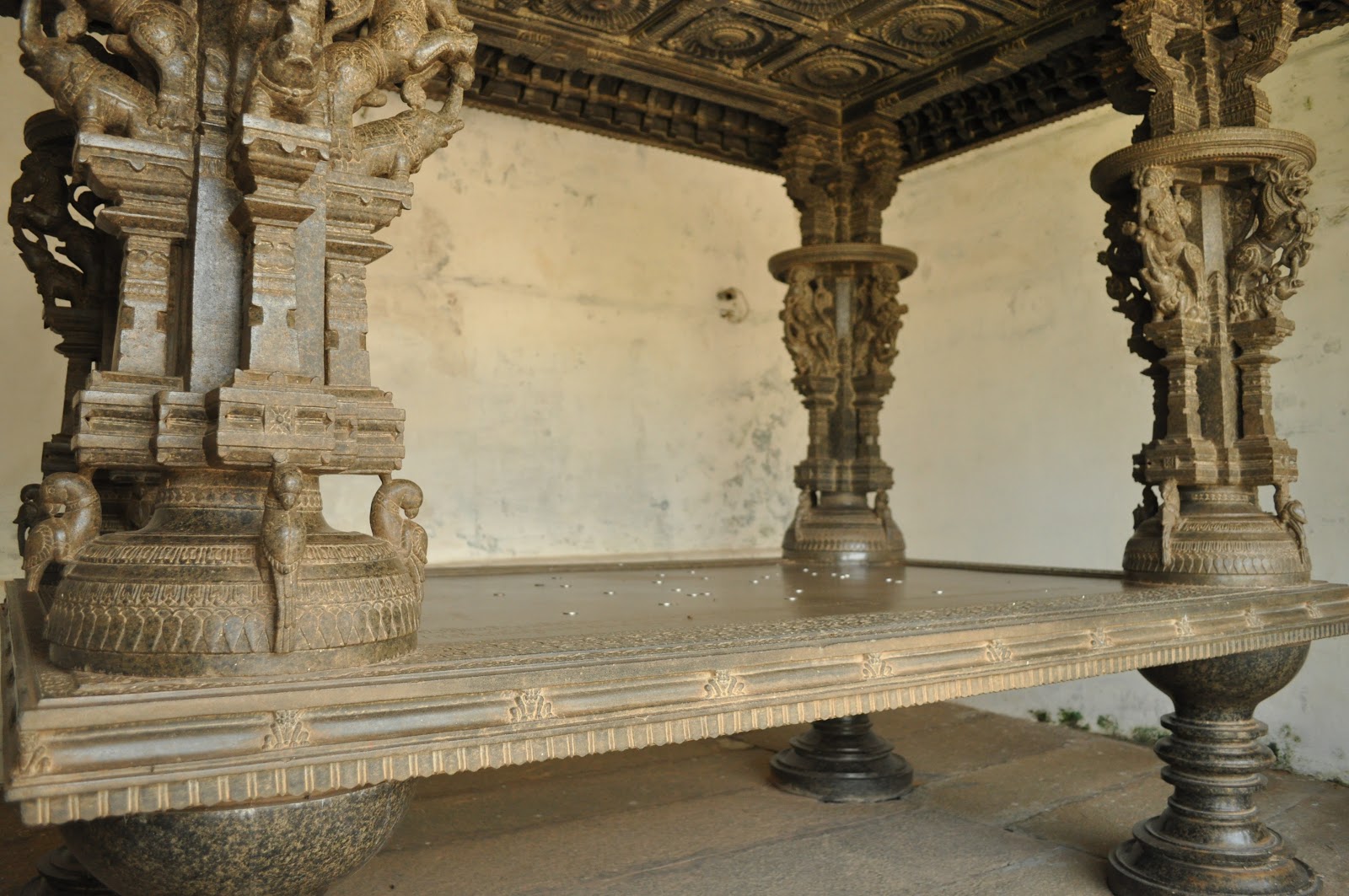
Onte Kallu Mantapa

Banavasi is a true-blooded Kannadiga pride temple town. Not only was it considered the first capital of Karnataka, it was also the birthplace for Kannada’s first poet, Adikavi Pampa. Few coins discovered here a few years ago, date back to the 5th Century with Kannada inscriptions on it. This means that the existence of a mint factory here can be considered amongst the oldest in the country.
When we arrived here, we found out, much to our dismay that there were no ASI guides who could give us a sneak peek into the history of this magnificent temple. But just as we were loitering around clicking pictures, a priest herded us together and starting giving us a guided tour of the temple. Even though we knew pretty well that there was no such thing as a free meal, we didn’t mind paying the priest for an insight about the temple.  The priest began by giving a brief history of the temple built by the Kadambas and subsequently renovated and improved upon by the Chalukyas and Hoysalas. He told us the reason behind the Shivalinga being called Madhukeshava. The large linga here is in the color of honey (madhu) contrary to the black that we see elsewhere. He also talked about the specialty of the large bell outside the garba griha. This bell made from pancha loha (5 metals) is unique because the gong of the bell rings for close to a minute. He then showed us the Triloka Mantapa carved out of a single stone. It is undoubtedly the work of the Hoysala craftsmen. It goes without saying that such artwork can only be produced from the Hoysala breed of artisans. This is followed by the trademark Hoysala pillars, that’s a common garnish in every Hoysala Temple. The concave and convex reflective pillars not only accentuated the viewing experience of the performing dance artists but also speaks volumes of the mastery of these stone artists.
Can you spot the right eye of Nandi?
The Onte kallu Mantapa (single stone mantapa) is yet another classic from the Hoysala staple – again, carved from a single stone. The other notable and no less artistic brilliance is the Nandi statue. The first thing most of us might straight-away notice is that the Nandi is not directly looking at Shiva but is rather looking slightly to the right. The reason behind this is that while Nandi’s left eye is looking directly at the Shivalinga, its right eye is looking at Parvathi which is separate temple adjacent to Shiva’s. Such is the mastery of the stone artisans of that era that despite a maze of pillars, the right eye of Nandi is transfixed on Parvathi Devi. Unbelievable? Well, you can confirm it yourself by standing in front of the Parvathi temple and looking at Nandi. Another important attraction here is the Ardha Ganesh. This statue of Lord Ganesh is split vertically right at the middle. It is believed that the other half is in Kashi.
These are only some of the stand-out features of this temple. By the end of it all we were left dizzy with amazement. With the Sun beating down hard we decided to spend a little more time admiring the place. After all it’s not every day you get to be a part of history. All that textbook knowledge of our History lessons look so worthless compared to the couple of hours we spent here.
Now did I say there’s-no-such-thing-as-a-free-meal a while ago. Ok, I take that back, because there was a free anna daanam in the temple served at exactly 1PM. We devoured the hot rice, blistering sambar and the super cool majige like there’s no tomorrow. With a content stomach and heart we started for the next leg of our Sirsi trip – Sahasralinga.
 
Getting-there: Approx 30 kms from Marikamba Temple.
Must-Do: Ask the priest for a guided tour. Free Anna Daanam at 1PM.
Must-Don't: Vandalism and Littering
My Rating: 8/10

Thursday, October 06, 2011

Chennakesava Temple, Somanathapura.

Every travel has a purpose. As did this one. The purpose being pushing the throttle on a 350 CC brand new you-guessed-it Royal Enfield. Well no, I was not the lucky soul pulling the clutch and shifting the gears. I was still stuck with my Yamaha FZ 16. The only time I use the word “stuck” is when I’m comparing with RE.

Seeking Somanathapura for testing this beast of a machine (by Indian standards) was a no-brainer. 130kms of flat-as-a-runway glistening asphalt is a biker’s definition of “paradise on earth”, unless of course you are talking about “The Himalayan Odyssey Challenge”.

The annoying potholed roads of Bangalore first gave way to the less-than-decent Kanakapura Road and finally to what we have been waiting for – Mysore Road. A wise man once said, “It’s not the destination but the journey that matters”. This holds true for Mysore Road. It’s an entirely different world the moment you get on it. In the third gear, the Yamaha and the Bullet kept abreast with each other at about 50kmph. And in the fourth gear, the Bullet throttles ahead with a new found gusto. While Yamaha revs up to about 65kmph, the Bullet touches about 75kmph. And finally in the fifth gear when the FZ is going steady at 80kmph the bullet leaves everything behind to touch 100kmph without breaking a sweat.

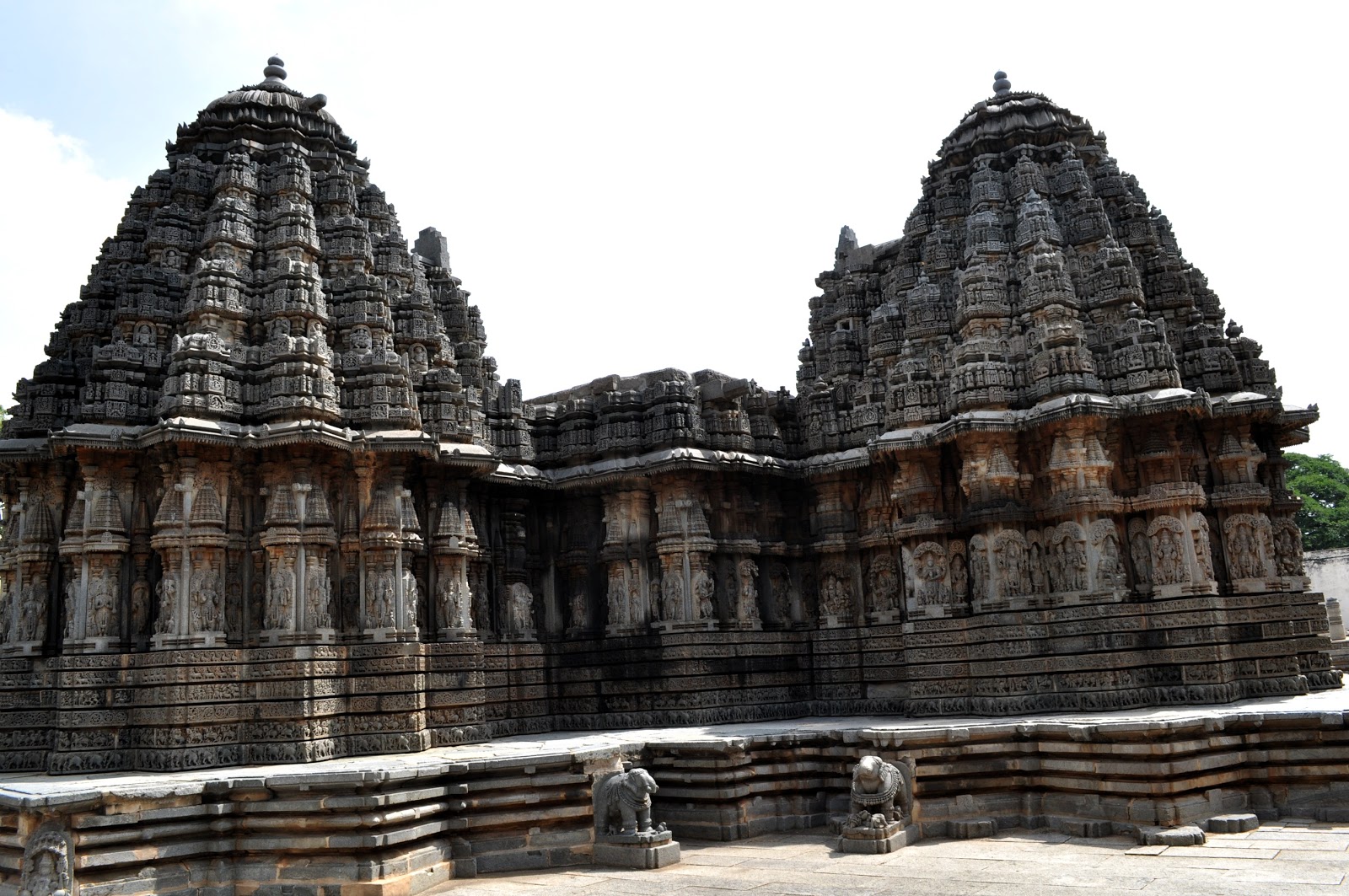
Somanathapura is a quiet town in Mandya district, 35kms from Mysore city and approximately 130kms from Bangalore city. The main and only attraction of this village is the famous Chennakesava Temple. This temple completes the famous trio of Hoysala temples along with Halebidu and Belur. It was built in the year 1268 by a Commander Somanatha in the Hoysala kingdom. A large stone with Kannada inscriptions tells the tale of this village.

Chennakesava temple here is less magnificent compared to its more illustrious cousins in Halebidu and Belur. But it adheres to the blueprint of all Hoysala temples with the star-shaped structure, the richly adorned ceilings, depiction of ancient folklore in exterior walls and the finely polished pillars which is the mainstay of every Hoysala temple ever built. The three sanctum sanctorums each house Lord Kesava, Janardhana and Venugopala. Unfortunately, the main idol of Lord Kesava, which is usually very well adorned, is missing.

Anybody who loves the Hoysala style of architecture or who appreciates the artistic brilliance of our forefathers will love spending time here admiring the artistry.

Getting-there: Bangalore -> Srirangapatnam on Mysore Road. About 3kms before Srirangapatnam, take a left deviation. Ask for directions from the locals from here.

Must-Do: Take a closer look at every stone, for they tell a story of their own.

Must-Don’t: Vandalism and Littering.


My Rating: 6/10

Wednesday, July 20, 2011

Belavadi, Chikmagalur.

After a choc-a-bloc itinerary at Chikmagalore, I suggested Belavadi to the group. Surprisingly, none objected despite the tiring walks, blood loss treks, bumpy jeep rides and sinful dosa-indulgence . I guess we were all more energetic at the fag end of the trip than we were at the start! That’s what an exhilarating mountain ranges can do.

The fact that we did not have to take a detour (rather just a deviation) on our way back to Bangalore made the idea more appealing. Belavadi for some reason does not figure in the itinerary of tourist visiting Belur-Halebidu even though its just 10 kms from Halebidu. Belavadi is comparatively less popular than its more illustrious cousins. I guess that’s because Belavadi is not as richly adorned as the other two. But that still shouldn't take anything away from the skill of the Hoysala sculptors. Let’s just say, that Halebidu and Belur has been more "attention" than the rest.

The Belavadi Veera Narayana Temple lies in the Chikmagalur-Javagal route, some 30 kms from Chikmagalore and 10 kms from Halebidu. One of the unique features of this temple is that it has three shrines, out of which two of them are facing each other. This Vaishav temple has three forms of Lord Vishnu. The central shrine has Lord Narayana, the southern has Lord Krishna and northern has Lord Narasimha.

The Archeological Survey of India has voted the idol of Lord Krishna here as the most beautiful of all Krishna sculptures in the world.

Another feature that is uncharacteristic of Hoysalas is that this temple is not star-shaped. In fact the shrines of Lord Krishna and Lord Narasimha were added later on. A trip to this idyllic village is a truly rewarding experience. For all those people who plan on visiting Belur-Halebidu, let me suggest an addition to that list – Belavadi.


PS: While you are here, you can walk some 300 meters to the adjoining Ganesha Temple. Visit the temple and ask the priest about its significance. You will be pleasantly surprised by what you hear.

Getting-there: On the Chikmagalore-Javagal Route, by-passing Hassan.

Must-Do: Visit it in the late evening, to get a good silhouette image - if you are a photographic buff.
Must-Don't: Vandalize or deface the rich heritage of this country.

My Rating: 7/10

Credits: Wikipedia
A Good Read: Temples of Karnataka

Sunday, November 14, 2010

Amruteswara Temple, Chikmagalur.

Located 67kms from Chikmagalur is yet another masterpiece from the highly skilled hands of the Hoysala sculptors. The Amruteswara Temple situated 10 kms from Tarikeri in Amruthapura stands testimony to the greatness of the Hoysala kingdom and their love for constructing jaw-dropping temples. Built in 1196 by Amrutheswara Dandanayaka under Hoysala king Veera Ballala II, the Amruteswara temple apparently built similar to the Veera Narayana temple at Belavadi – also in Chikmagalur.
Amruteswara is part of the Belur-Halebidu clutter of Hoysala temples, but less popular compared to their peers- thankfuly. It is also not being promoted as a tourist destination the temple itself is being maintained pretty well. The lack of tourists might also be one contributing factors to this. The Hoysala workmanship is prominent in every wall and every stone.
Ruvari Mallitamma is credited to be the Sculptor of this temple. The temple has a long hall with the trademark Hoysala pillars followed by a closed shrine, where the deity is still being worshipped. The idols here have all the skills and mastery that every famous Hoysala sculptor is endowed with. Ramayana and Mahabharata and etched into stone all across the exterior temple walls.
For all those who love poetry-in-stone, this temple offers a great deal to wow-about. One could make it part of the Belur-Halebidu itinerary along with Belavadi.

Credits: Wikipedia

Getting-there: Chikmaglur -> Birur -> Tarikeri -> Amruthapura. Local buses available till Tarikeri. From there, one would need to take an Autorickshaw. Nearest railway station is Birur/Kadur. It’s also 35 kms from Shimoga.


My Rating: 7/10

Monday, July 12, 2010

Chennakeshava Temple, Kaidala

Situated about 80kms from Bangalore, Kaidala is quite literally off the tourist map. So what was my object of interest in Kaidala? The 12th century Chennakeshava Temple built by Jakanachari was something I did not want to miss, especially considering its proximity to Bangalore city. Continuing with my Hoysala Trail which began with Halebidu and Belur I was surprised and excited to hear Tumkur having its own little piece of Hoysala history.

Kaidala is the hometown of Jakanachari – the sculptor-in-chief of the Belur Chennakeshava Temple. What really attracted me to Kaidala was the legend surrounding the temple.

Jakanachari a famous sculpture leaves behind his wife and unborn child and travels far and wide to gain name & fame. Sculpting beautiful statues, constructing temples over a long period of time he forgets his family. He reaches Hoysala kingdom where he agrees to sculpt deity Lord Chennakeshava. Meanwhile his son, Dankanachari leaves home in search of his father. On the day before the Chennakeshava idol has to be installed in Belur, Dankanachari reaches the place & claims that there is a flaw in the idol, Jakanachari refuses to accept that there could be a blemish and proclaims that he will cut off his own hand if a flaw is found.
A test was conducted and the statue was covered with sandal paste, and to his surprise the paste dried up everywhere except in the navel area. They find a live frog living in the sand and water nestled inside the cavity. Jakanachari cuts his hand after his son finds the flaw. Hence the statue became famous as ‘Kappe Channigaraya’ (Kappe means Frog in Kannada).
Later Jakanachari gets a vision to construct a temple at his home town. The father-son duo then moves to Kaidala where it is said that Jakanachari got back his hand after he completed the Chennakeshava statue.

Reaching Kaidala proved a little challenging. While at times we were greeted with empty expressions, at other times we encountered a shake of the head. Then there were those who confused Kaidala with Maidala a neighbouring village and almost sent us on a wild goose chase. But we did eventually made it to the Chennakeshava temple, thanks to some really friendly locals who went out of their way to help us.

Once there, we realized why Kaidala never made it to the tourist map. The Kaidala Chennakeshava temple structure is nothing compared to its more illustrious cousins in Belur and Halebidu. What makes it worse is the fact that ASI has undertaken some restoration work with the temple. And apparently they did not deem it necessary to try and blend new additions into the ancient structure. The result is an ugly mismatch of two different worlds.

As it turns out, the only noteworthy object about the temple is the sculpture of its presiding deity - Lord Chennakeshava. The soap stone composition and exquisitely adorned idol brings back glimpses of sculptural mastery from the Hoysala era. The temple here is still worshipped and hence I deemed it right to not take pictures of the deity.

But for the sculpture of Lord Chennakeshava, sadly there’s nothing of interest in this part of the world. As for me, I’m just glad to have experienced another sculptural marvel from the Hoysalas.


Getting-there: Take the NH4 out of Bangalore to Tumkur. Take the bye-pass road a little before Tumkur town (right after where the Toll gate ends). A little tricky as there might not be any signboards - we missed it too. Then turn left at SH33. From here you can ask the locals.

Must-Do: A mini orchestra machine which has an assortment of music creating devices, the size of a house-hold grinder. I wonder if it can play any music though!
Must-Don’t: Vandalism.

Caution: The pictures provided by karnataka.com are those belonging to the Belur, Hassan and not the one at Kaidala - just so that you dont feel cheated if and when you do happen to go there.
My Rating: 3/10

Tuesday, March 30, 2010

Belur, Hassan.

Halebidu and Belur though taken in the same breath are actually 17 kms apart. You cannot however come to either one of the temples and not see the other. The Chennakeshava temple in Belur is not very spectacularly different from the Hoysaleshwara temple in Halebidu. Considering the fact that the two temples were built in the same century (or there abouts) it’s no surprise, they resemble almost the same. In fact, you will find at least four or five duplicate sculptures between Halebidu and Belur temples.

Whilst comparing the two temples it’s not hard to notice that the Belur temple is only half the size of the Halebidu temple. Another major difference one would notice is that the Belur temple is thankfully complete - after 103 years of artistic perseverance.

The Chennakeshava temple was built by fourth ruler of the Hoysala dynasty after he was converted to Vaishnava faith from Jainism by sage Ramanuja.The most striking architectural marvel of the Chennakeshava temple is the richly adorned Narasimha pillar. Until the 18th Century one could turn the pillar at will which used to be suspended from the equally adorned ceiling. But the wrath of nature took its toll when the roof from where the Narasimha pillar was hanging slightly caved-in covering the tiny gap between pillar and the pedestal. The Narasimha pillar is one among the forty-six distinctly carved pillars in the temple. Such is the wizardry of the Hoysala sculptures that one could notice that the earrings on the lobes of the dancers could be rotated. They have even carved stones into the pendants of the dancers. You could also notice the gaps between two overlapping necklaces!
Sadly, this temple has also not been spared of vandalism from the countless visitors and treasure hunters. And despite this vandalism the government apathy continues with no police presence to guard this invaluable Indian culture. Funnily the only two policemen posted at the entrance of the temple diligently check for cell phones of every visitor and deposit it with them for the time of their visit. I’m sure they would go back home with their head held high for saving an Indian monument!!
Such is the brilliance of these stone poets that devotion takes a step backward. You constantly need reminding that you are in a holy place and that presiding deity should be getting all the attention rather than the magnificence of the sculptors. Halebid and Belur are a must-visit for those searching for the rich Indian Heritage and culture. Truly mesmerizing and worth all the trouble getting there.

Getting-there: A couple of Trains and numerous buses ply from Bangalore to Hassan frequently. From Hassan it’s another one hour to either Halebidu or Belur.

Must-Do: Engage a guide to take you through the interpretations of the epics depicted in stone.

Must-Don’t: Engage in vandalism or speed-up the destruction of such great works of art.


My Rating: 9/10

Monday, March 22, 2010

Halebidu - II, Hassan

A short half km walk from the Hoysaleshwara temple in Halebidu and you find yourself at two more such temples from the same era - the Basadi Halli (Jain Temple) and the Kedareshwara Temple. The Kedareshwara temple looks an exact replica of the Hoysaleshwara temple except that it has only one entrance as opposed to three of the latter.
Basadi Halli: This temple is about 300 mts from the Hoysaleshwara temple and less visited by the tourists who come to Halebidu. In fact we found the temple totally deserted but for a local who was found enjoying his afternoon siesta. The notable wonder of this temple is the richly polished stone pillars where you can actually see your image, and that too inverted! Though its a Jain Temple, the Sanctum Sanctorum belongs to the bats!

Totally deserted and quiet temple but thankfully not much vandalized. Do not miss it if you have made it to Halebidu.

Kedareshwara Temple: Another 200 meters from Basadi Halli and you reach the Kedareshwara Temple. Built in 1220 AD this temple still stands majestic in its wake braving all the odds. More info about the temple can be found here.
Unfortunately the temple is locked but you can peep through the door and see the inside of the temple as there is enough natural light that come through the perforated walls of the temple.

A must-visit if you have made it to Halebidu.

My Rating: 8/10

Thursday, March 18, 2010

Halebidu, Hassan


Other names: Halebid, Dwarasamudra.

After yet another cancellation of a Wayanad Trip (it's become totally jinxed now!) we made a hurried plan to visit Halebidu and Belur since we had only one day to spare.
Caught a 6 AM Karnataka Sampige bus from Kempegowda Bus Station, Bangalore and reached Hassan by around 10:30. From there we took another bus and reached Halebidu by 11:30.
The 12th Century Hoysaleshwara Temple stood majestically in the blazing sun. And no, I’m not talking about ruins here. Every stone, that has not been vandalized, stands its ground. Quite unbelievable that a 12th Century monument braved the wrath of nature and more importantly careless human vandalism.
When you come to a place as historic as this, it would be criminal to not engage a guide and learn more about the place. For Rs. 200 (with a receipt) you would end up earning more than you bargained for. Our guide turned out to be quite eloquent with the history of the temple and Hindu mythology in general. Hence you can imagine our shock when we found out that he was actually a Muslim! It was quite embarrassing to note that a Muslim knows more Hindu mythology than (a Hindu) me.
Coming to the artwork of the temple, all I can say is that it will blow your brains out of your skull. The imagination, the visualization, the talent and the execution is simply numbing. Attention to detail is buzzword among the Hoysala sculptors. Giving shape to their imaginations looks like piece of cake for these extremely skilled craftsmen. Jakkanna Achari is believed to be the chief architect of the Hoysala Temples in Halebidu and Belur.

The Hoysaleshwara temple is dedicated to the King Vishnuvardhana Hoysaleshwara. The temple was built by one his Ministers. The temple has two main Nandi idols. The 9 ft Nandi is dedicated to King Vishnuvardhana and the 8 ft Nandi is dedicated to his queen Santhala. The facts regarding the temple, its idols, its structure (like a star), it’s artwork, it’s story telling through sculptures are all but staggering. Just when you find a dynasty spending 87 years with thousands of money and manpower as shocking, comes the biggest shocker of all. This city and hence with it, the temple, has been abandoned by the Hoysala rulers after two attacks by the Delhi Sultanate and then shifted base to Belur where they undertook the exercise all over again!
Two hours after we started our tour of this magnificent temple, we still wanted more of it! And more is what we got in the form of the Jain Temple and the Kedareshwara temple just half a kilometer behind the Hoysaleshwara Temple. The Kedareshwara temple is just like an extension of the Hoysaleshwara temple, whereas the Jain temple has some finely polished stone pillars where you can see your reflection – inverted!!!

While we were at Kedareshwara temple it started to rain, the first for the year, and it was just magical. The soapstone structure of these temples suddenly looked all the more appealing. We surely got more than we bargained for, from this trip to Halebidu, talking of which we still have Belur to devour…
Getting-there: Frequent KSRCT buses ply between Bangalore and Hassan. From Hassan you can take a bus to either Halebidu or Belur, whichever you chose to cover first.

Must-Do: Engage a guide to get a sneak peak into Hoysala Dynasty and interpretation of the sculptures.

Must-Don't: Vandalize the rich culture of our country!


My Rating: 9/10