Saturday, October 27, 2012

Marikamba Temple, Sirsi

A trip to Sirsi has been in the offing for quite a while. The plan was made at least 2 years ago. The idea was simple – cover as many waterfalls as possible in given time between August and October. The timing was important because this was the time when the monsoons would have abated leaving the waterfalls packed to capacity. But as the plans got serious and looked on the verge of being conquered thanks to a few enthusiastic co-travelers cum nature lovers cum awesome friends, the plan started taking a different shape and dimension.  My biggest learning before and during this trip was that Sirsi was not all about waterfalls. This sleepy little town is rich in cultural, linguistical and mythological heritage. Sirsi is as much about the cultural heritage of Karnataka as it is about the waterfalls. Add to that, there are so many places of mythological significance that it is difficult to cover Sirsi in a weekend. You definitely have to devote at least a couple more weekends to experiencing Sirsi.

After Alemarigalu’s planned Sirsi trip got cancelled because of drop-outs this time we fixed a quorum of 5 members to make a trip out of it. And 5 we were to explore the wonderful land of Sirsi. Our first stop after freezing bath in a canal was Sri Marikamba Temple.

Sri Marikamba Temple is a 17th Century temple located at Sirsi in Uttara Kannada. Marikamba is believed to be the Goddess of Power by Her devotees.  The seven foot tall wooden idol of the deity was resurrected from a tank near Hangal and a temple built for Her in the year 1689. Local puranas mention the deity as Renuka or Yellamma. She is also referred to as Doddamma – elder sister to all younger Mariammas installed in different villages and towns. She is believed to control evil spirits and epidemics. So in order to appease Her, devotees used to offer animal sacrifice. But all that changed in 1933 when Gandhiji  visited Sirsi but refused to enter the temple considering the brutal animal sacrifices that were performed here. Distinguished citizens like SN Keshwain and Vitthal Rao Hodike started educating the masses against this inhuman practice. They even went to the extent of kidnapping the buffalo the night before the sacrifice and have the courage to face an angry mob. Eventually the masses relented and the practice of animal sacrifice was finally banned.

The Marikamba Temple is also famous for its Kavi art. The temple walls are adorned with artwork from famous local artists. These wall murals depict episodes from the Ramayana and Mahabharata. The first impression of the temple is that it looks nothing like a South Indian temple and that impression stays throughout, thanks to the wall murals. It is unlike any temple you will ever see in South India. Here’s why you should you visit Marikamba Temple:

1.       It’s bang in the middle of Sirsi town

2.       The wall murals on the temple depicting episodes from our epics

3.       Take inspiration from the fact that God will be appeased even if animal sacrifices aren’t done

4.       Learn about how the courage of two brave and educated men can change age-old customs for the better.

5.       It is en route Banavasi Madhukeshava Temple.

6.       Because 5 reasons are good enough to go there!

Getting-there: Right in the heart of the town.
Must-Do: Check out the murals adorning the temple
Must-Don’t: Animal sacrifice of course. Photography of the deity.
My Rating: 7/10

Information Credits: Kamat's Potpourri

Chikka Tirupathi, Sarjapura

We wanted to make the best use of our Ayudha Pooja holiday besides the fact that we wanted to take our little one out on a long drive.  Considering that the little one hadn’t gone on a long drive yet, we wanted to go somewhere near, yet comfortably out of Bangalore. After a good look at the options, we zeroed-in on Chikka Tirupathi. Comfortably placed at 32 kms from house, the ride to this miniature Tirupathi seemed ideal.

Chikka Tirupathi is located 10km further of Sarjapura. There’s no chance you will get lost reaching this temple. It’s just one straight road till Sarjapura. From here you need to take a left. 10 kms later you will be at the door step of Lord Venkateshwara. Now if you are wondering why this temple is called a mini-Tirupathi, it is because this one is a replica of the actual temple in Tirumala. Also, all the festivities and poojas performed in Tirumala are also performed here. There are also some mythological stories associated with this temple.  It is believed that  Agni during incineration of the forests of herbs, causes burn injuries on serpent Lord Takshaka. Enraged by this act, Takshaka bestows a curse on Agni that he would lose his powers. Disturbed by this event, He rushes to Lord Krishna for advice, who suggests Agni to perform a penance to appease Lord Vishnu. A dedicated penance later, a pleased Lord Vishnu performs a shaapa vimochana for Agni. A joyous Agni  builds a temple for Lord Venkateshwara, aptly named, Prasanna Venkateshwara.

Surprisingly, there were hardly a handful of devotees, especially since it was a festive day. A quick darshan later we spent a few lazy moments there before heading back to Bangalore. On the way back, we stopped at the Kochu Guruvayoor temple, but it was already closed for poojas.

The ride till Dommasandra is nothing worth writing about. Its uneven and pot-hole ridden. However the road does better after Dommasandra till Sarjapura. Driving through the narrow market lanes of Sarjapura is a nightmarish experience, especially when careless people do not think twice before leaving a scratch on your car. The final 10 km stretch is beautiful ride through the idyllic villages. The well-laid winding roads and cool breeze settles the case that you are finally out of Bangalore – if only for a short while.

Getting-there: Take right at Iblur Junction on Sarjapur Road/ORR and continue till Sarjapura(approx. 20kms). After Sarjapura town take left and follow the signboards for the final 10 kms.

Must-Do: Drive carefully through Sarjapura town. Best to go in a hatchback than a sedan.
Must-Don’t: Littering along the way and near the temple.

My Rating: 5/10

Photo and Content Credits: Alemaari

Thursday, October 04, 2012

Kalil Temple, Methala, Perumbavoor, Kerala

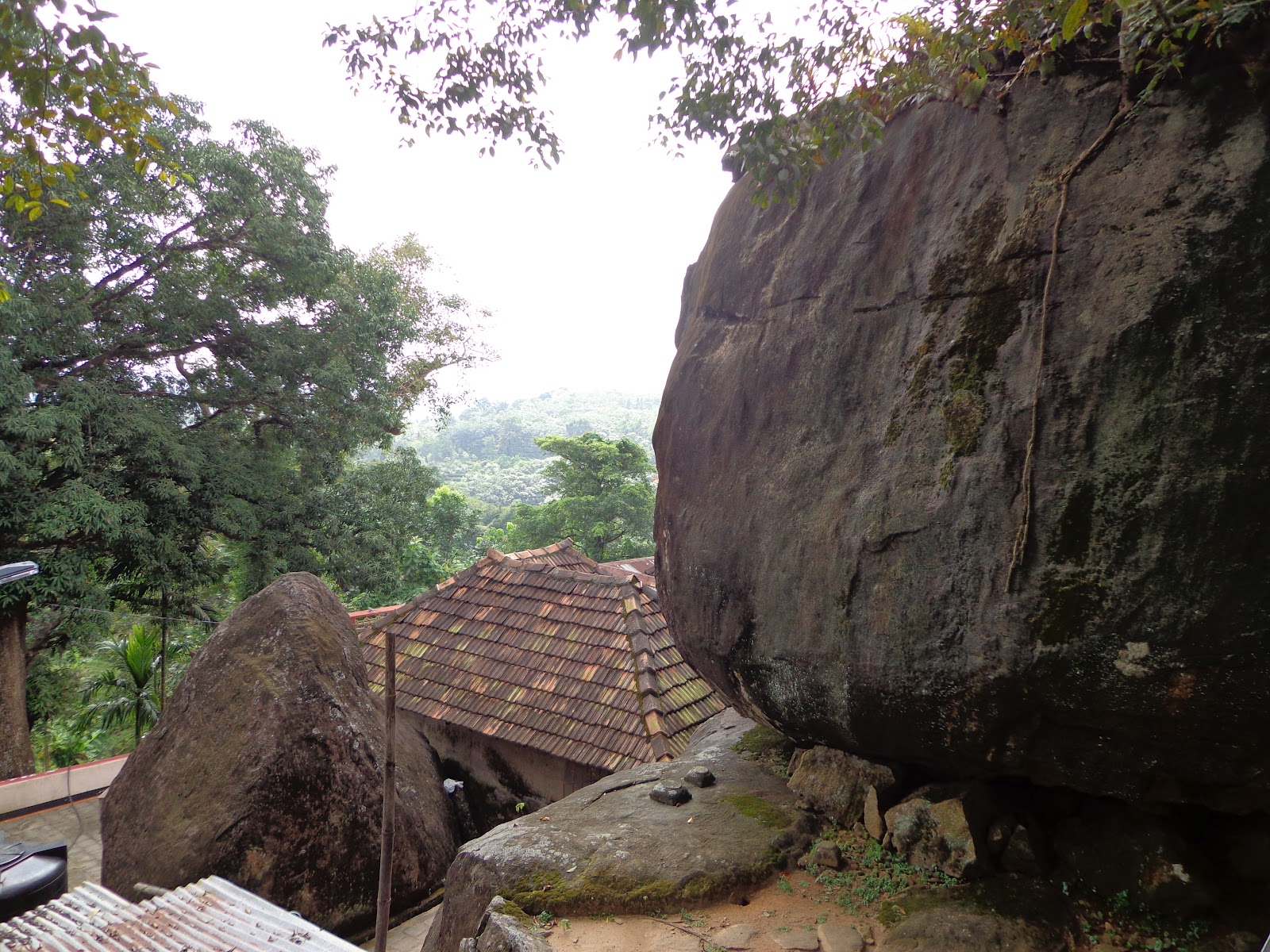
Kalil Temple was originally a 9th Century Jain Temple situated in Methala near Perumbavoor. The temple sits on a hill under a huge rock. A rocky terrain and a final flight of about fifty steps brings you to this mysterious temple. I say mysterious because, surprisingly only one portion of the huge rock touches the ground and there is no support whatsoever. Although on the other side of the suspending rock are the temple walls, it has to be noted that the walls were a later addition. Hence the mystery of the suspending rock lingers, which draws devotees to this cave temple. On top of the cave temple is a carving on the rock. There is some confusion over who that image belongs to. Some claim it to be Brahma while others claim it to be Mahaveer Jain.

The erstwhile Jain place of worship is now a Hindu temple with Bhagavathy Devi sitting pretty as the main deity here, which brings us to the second mystery of the temple. It is clearly obvious to any devotee that the idol of Bhagvathy Devi does not sit in the centre of the Sanctum Santorum (in the doorway) but visibly to the right. Meaning, to see the idol the devotees have to go the left of the doorway. Apparently this was not the case many years ago. The popular belief is that the idol is moving on its own without any human intervention. There is a third mystery attributed to this temple. Apparently a few years ago, on one of the rocks there, people have started observing the markings of what looks like Lord Shiva. And as the years pass by the carving is becoming more and more visible. Nobody knows how the markings are becoming more distinct and legible. Currently the face and upper body can be clearly ascertained.

Up until recently the temple would close by noon after the poojas and not open in the evenings (a rare occurrence in temples of kerala). This can be attributed to the belief of existence of evil spirits in the dense forest there. But since a year ago, the temple is thrown open in the evenings and poojas performed. All the mysteries attributed to the temple gives a special aura to the temple.


Getting-there: About 10 kms from Perumbavoor town in Aluva en route Muvatupuzha.

Must-Do: Check out the suspending rock, displaced Bhagvathy idol and the self appearing rock carving.
Must-Don’t: Clicking pictures inside the temple.

My Rating: 8/10

Thrikkariyoor Mahadeva Kshetram, Kothamangalam, Kerala.


Shiva Temple
 The Thrikkariyoor Shiva Temple is considered to be the last pratishta of Lord Parasurama. It is the last among the 108 Shivalayas consecrated by Parasurama. Legend goes that, Lord Parasurama (sixth incarnation of Lord Vishnu) created the land between Gokarna and Kanyakumari. After many years of penance Parasurama invoked Lord Varuna (Lord of the Oceans) to absolve Himself of His sins. Parasurama wanted to donate some land to the Brahmins and asked for this boon from Lord Varuna. Varuna gave Parasurama an axe and asked him to throw it as far as possible. The distance the axe covers from Gokarna will be given to him. The axe thrown from Gokarna landed in Kanyakumari, thereby creating the land (Kerala) for Brahmins. After this, Parasurama set about establishing 64 villages and consequently 108 Shiva temples in that stretch. Apparently Thrikkariyoor is where Parasurama attained Salvation.

It is also believed that this temple contains the spirits of Lord Shiva and Lord Krishna. But there isn't much info behind the reason for this belief. Another significance of Thrikkariyoor is that it is believed to be Capital of the Chera Dynasty. Some historians even claim that Thrikkariyoor is the modern Karur, although there is not much support for this theory.

Bhagvathy Temple

It is a comparatively large temple with medieval architecture. There is a calmness about the temple that will put your mind at peace - something that I look for in temples. The quietness and solitude of this holy place makes you feel a lot closer to God. Being walking distance from my maternal ancestral home, I've been here umpteen times. And every time I was here I just love the atmosphere and the cosmic energy projected at me. Refreshed and invigorated I head to the Bhagvathy temple bang opposite the Shiva Temple before returning home to relax for the rest of the day.

Getting-there: Thrikkariyoor is 4 kms from Kothamangalam town in Aluva (Ernakulam District, Kerala).

Must-Do: Obey the dress code.
Must-Don't: Miss a visit to Bhagvathy Temple opposite to the Shiva temple.

My Rating: 6/10

Information Courtesy: vaikhari

Punnathur Kotta, Guruvayoor


Aana (foreground) with the Kotta (background)
The name Punnathur Kotta (Palace) evokes images of a stately palace steeped in distinct Kerala architecture with its open courtyards, sloping red tile roofs and ornate wooden carvings. It also evokes images of the royal scions of the Verma lineage inhabiting the Palace. But here's the shocker. The Kotta is more known for the happenings outside the Palace than inside. Its inhabitants all stay outside of the Palace in the open - all 63 of them. The only beings that command respect and love of the people of Kerala after the Royal Vermas are the Elephants of the state. And it is them that have made the Punnathur Kotta their home. These elephants belong to Guruvayoor Sri Krishna Temple. They have been donated by different devotees to the temple for its various festivities.


I cannot be more cuter than this
There are elephants of all sizes, shapes and ages here. The younger ones are trained to become future temple elephants. Luckily for them, these elephants are very well taken care of. They are given an elaborate bath, lots of greens to chew on and in most cases enough shade to stand in. And then there are the elephants in heat, which are kind of quarantined from the rest with a Warning signboard cautioning the visitors from getting close to these mammals.

The Punnathur Kotta (now known as Aana Kotta) is a 30 acre Elephant Park in an erstwhile Palace of a local Ruler. It’s a nice way to relax in the hot Kerala sun after a visit to Guruvayoor Sri Krishna Temple and the Mammiyoor Temple. Children will especially love this place as they get to see so many live Jumbos up close and personal. And if you are lucky, you might even get to see the little kutti-aanas too. We weren't.

Getting-there: About 2 kms from Sri Krishna Temple and 1km from Mammiyoor Temple. For about Rs.130 an autowallah will be willing to cover this circuit, including an acceptable waiting period.
Ah... What a Life!

Must-Do: Try to get a glimpse of the cub elephants.

Must-Don't: Getting too adventurous and venturing close to the elephants (especially the ones in heat)


My Rating: 5/10