Wednesday, October 12, 2011

Sri Krishna Temple, Guruvayoor

The Sri Krishna (or more fondly, Sree Guruvayoorappan) Temple in Guruvayoor is probably the most important temple to Malayalis in Kerala - perhaps more important than Sabrimala. But that’s not a debate I want to venture into. This temple has a lot of perceived and factual history attached to it – history that goes back to 5000 years.


According to folklore, Lord Krishna knew that after his time on earth, Dwaraka will be submerged under the sea. He however wanted his Vishnu idol to be worshipped by others. Hence he instructed Deva Guru and Vayu Deva to take his Vishnu idol to someplace safe and allow devotees to worship it, before Dwaraka is submerged. Deva Guru and Vayu Deva on their part found the ideal resting place for the Vishnu idol. Unfortunately, there was a Shiva idol already in that place. Deva Guru however prayed to Lord Shiva, who obliged to move his own idol to a different location – now known as Mammiyur, a kilometer away from this temple. The temple town thus got its name from Deva Guru and Vayu Deva.

But it has not been so smooth sailing for the temple. It was time and again plundered by different rulers and fire mishaps. In 1716 AD The Dutch had plundered and set fire to this shrine. In 1766 AD Haider Ali captured Calicut. But the temple was spared after a huge ransom was paid to the ruler. In 1789 his son Tipu Sultan set fire to the temple. But before he could do that the main idol was hidden underground and the procession idol shifted to Ambalapuzha. During the time of the British, the idols were reinstalled and the temple started to prosper. In 1970 a fire broke out in the temple, causing quite some damage.

The temple unfortunately is under the control of very Orthodox Brahmins. It was only in 1930 that untouchables were allowed into the temple. But non-Hindus, to this date are not allowed into the temple. The most glaring irony is that, despite the temple opening its doors with the melodious voice of KJ Yesudas’ devotional renderings, he has been denied entry into the temple on multiple occasions for being a Christian. It’s a sad state of affairs, this partisan treatment of devotees by the temple authorities.

This temple is also the most-sought-after location to get married. The number of weddings happening here in a day during peak seasons is mind-boggling. The crowds are so huge in numbers that there were occasions when grooms and brides were mistakenly exchanged.


Getting-there: Guruvayoor is about 30kms from Thrissur Railway Station. From Thrissur you can either go by road or rail.

Must-Do: There’s very strict dress codes for men and women. Men must wear mundus (white or saffron only). Pants and shorts not allowed. Men must be bare-chested. Women must wear saris, salwars and chudidhars only. Until recently only saris were allowed.
Must-Don’t: Consume Alcohol. Strictly no-alcohol area.

Caution: Maddening crowds during festivals and marriage seasons.
My Rating: 6/10
Credits:
http://www.guruvayoor.org/history.htm#co
http://wikitravel.org/en/Guruvayoor

Thursday, October 06, 2011

Sri Ranganathaswamy Temple, Srirangapatnam.

The Sri Ranganathaswamy Temple is situated in the heart of Srirangapatnam about 35kms from Mysore and about 130kms from Bangalore. Srirangapatnam is perhaps more famous for being Tipu Sultan’s capital. In fact a lot of historic places related to Tipu Sultan are at a stone throwing distance away from this temple. Even though Srirangapatnam is more famous for being Tipu’s capital, it is in fact the temple that gave its name to the city. All Tipu-related monuments will be covered in a different blog at a different time.


For the time being I’ll stick to the Sri Ranganathaswamy Temple, which is located in the first island formed by River Kaveri. It’s a popular fact in this part of the world that Kaveri makes three islands in its course and in each of these islands there is a Sri Ranganathaswamy Temple. They are collectively called the three Rangas - the Adi (First) Ranga at Srirangapatnam, the Madhya (Middle) Ranga at Shivanasamudram and the Anthya (Final) Ranga at Srirangam. This temple is also among the famous Pancharanga Kshetrams (Srirangapatnam, Srirangam, Kumbakonam, Trichy and Mayiladuthurai).

Sri Ranganathaswamy temple was initially built by Gangas in the 9th Century as later taken care by Hoysalas and Vijaynagaras. But mostly the temple has a distinctive Gangas and Vijaynagaras style of architecture. The idol of Lord Vishnu here is in a reclining position. Being a temple with historical and religious significance, you can expect a decent crowd on weekends.


Getting-there: Bangalore -> Srirangapatnam. Take a right turn on Mysore Road at Srirangapatnam and follow the crowd.

Must-Do: Arrive early to beat the crowd.
Must-Don’t: Vandalism and Littering.

My Rating: 5/10

Chennakesava Temple, Somanathapura.

Every travel has a purpose. As did this one. The purpose being pushing the throttle on a 350 CC brand new you-guessed-it Royal Enfield. Well no, I was not the lucky soul pulling the clutch and shifting the gears. I was still stuck with my Yamaha FZ 16. The only time I use the word “stuck” is when I’m comparing with RE.

Seeking Somanathapura for testing this beast of a machine (by Indian standards) was a no-brainer. 130kms of flat-as-a-runway glistening asphalt is a biker’s definition of “paradise on earth”, unless of course you are talking about “The Himalayan Odyssey Challenge”.

The annoying potholed roads of Bangalore first gave way to the less-than-decent Kanakapura Road and finally to what we have been waiting for – Mysore Road. A wise man once said, “It’s not the destination but the journey that matters”. This holds true for Mysore Road. It’s an entirely different world the moment you get on it. In the third gear, the Yamaha and the Bullet kept abreast with each other at about 50kmph. And in the fourth gear, the Bullet throttles ahead with a new found gusto. While Yamaha revs up to about 65kmph, the Bullet touches about 75kmph. And finally in the fifth gear when the FZ is going steady at 80kmph the bullet leaves everything behind to touch 100kmph without breaking a sweat.

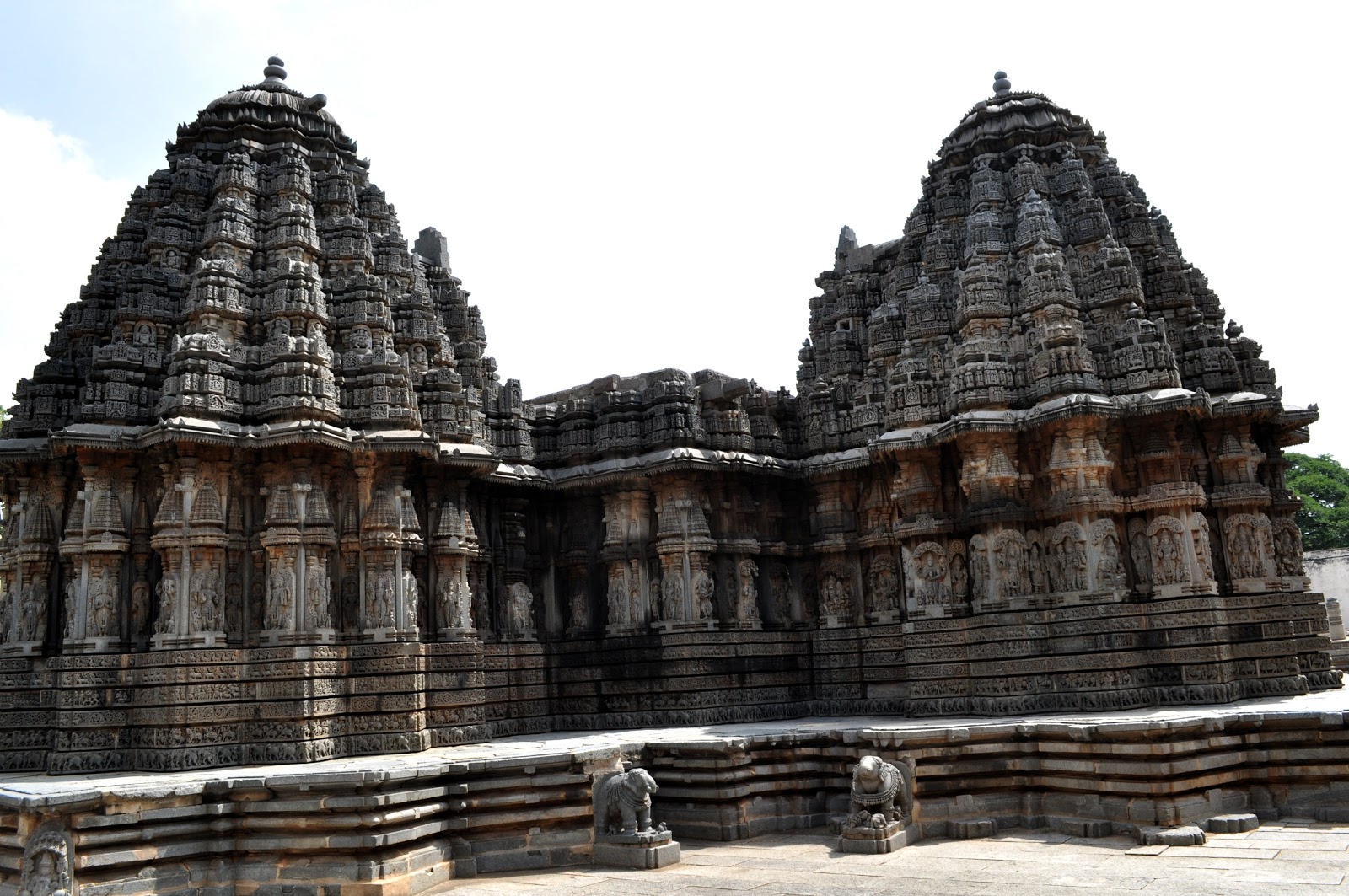
Somanathapura is a quiet town in Mandya district, 35kms from Mysore city and approximately 130kms from Bangalore city. The main and only attraction of this village is the famous Chennakesava Temple. This temple completes the famous trio of Hoysala temples along with Halebidu and Belur. It was built in the year 1268 by a Commander Somanatha in the Hoysala kingdom. A large stone with Kannada inscriptions tells the tale of this village.

Chennakesava temple here is less magnificent compared to its more illustrious cousins in Halebidu and Belur. But it adheres to the blueprint of all Hoysala temples with the star-shaped structure, the richly adorned ceilings, depiction of ancient folklore in exterior walls and the finely polished pillars which is the mainstay of every Hoysala temple ever built. The three sanctum sanctorums each house Lord Kesava, Janardhana and Venugopala. Unfortunately, the main idol of Lord Kesava, which is usually very well adorned, is missing.

Anybody who loves the Hoysala style of architecture or who appreciates the artistic brilliance of our forefathers will love spending time here admiring the artistry.

Getting-there: Bangalore -> Srirangapatnam on Mysore Road. About 3kms before Srirangapatnam, take a left deviation. Ask for directions from the locals from here.

Must-Do: Take a closer look at every stone, for they tell a story of their own.

Must-Don’t: Vandalism and Littering.


My Rating: 6/10

Friday, July 22, 2011

Images of 2010

I know it's a "bit too" late to post this. But, better late than never :)
Shangumugham Beach, Thiruvananthapuram
Hebbe Falls, Chikmagalur
Mullayangiri, Chikmagalur

Halebidu

Belur


Shree Padmanabha Kshetram, Thiruvananthapuram

Badami, Bagalkot.

Kaidala, Tumkur

Aaranmula Boat Race, Chenganoor
Shivagange, Tumkur

Amruteshwara Temple, Chikmagalur


Kalahasti Falls, Chikmagalur


Benaulim Beach, Goa

Palolem Beach, Goa

Wednesday, July 20, 2011

Belavadi, Chikmagalur.

After a choc-a-bloc itinerary at Chikmagalore, I suggested Belavadi to the group. Surprisingly, none objected despite the tiring walks, blood loss treks, bumpy jeep rides and sinful dosa-indulgence . I guess we were all more energetic at the fag end of the trip than we were at the start! That’s what an exhilarating mountain ranges can do.

The fact that we did not have to take a detour (rather just a deviation) on our way back to Bangalore made the idea more appealing. Belavadi for some reason does not figure in the itinerary of tourist visiting Belur-Halebidu even though its just 10 kms from Halebidu. Belavadi is comparatively less popular than its more illustrious cousins. I guess that’s because Belavadi is not as richly adorned as the other two. But that still shouldn't take anything away from the skill of the Hoysala sculptors. Let’s just say, that Halebidu and Belur has been more "attention" than the rest.

The Belavadi Veera Narayana Temple lies in the Chikmagalur-Javagal route, some 30 kms from Chikmagalore and 10 kms from Halebidu. One of the unique features of this temple is that it has three shrines, out of which two of them are facing each other. This Vaishav temple has three forms of Lord Vishnu. The central shrine has Lord Narayana, the southern has Lord Krishna and northern has Lord Narasimha.

The Archeological Survey of India has voted the idol of Lord Krishna here as the most beautiful of all Krishna sculptures in the world.

Another feature that is uncharacteristic of Hoysalas is that this temple is not star-shaped. In fact the shrines of Lord Krishna and Lord Narasimha were added later on. A trip to this idyllic village is a truly rewarding experience. For all those people who plan on visiting Belur-Halebidu, let me suggest an addition to that list – Belavadi.


PS: While you are here, you can walk some 300 meters to the adjoining Ganesha Temple. Visit the temple and ask the priest about its significance. You will be pleasantly surprised by what you hear.

Getting-there: On the Chikmagalore-Javagal Route, by-passing Hassan.

Must-Do: Visit it in the late evening, to get a good silhouette image - if you are a photographic buff.
Must-Don't: Vandalize or deface the rich heritage of this country.

My Rating: 7/10

Credits: Wikipedia
A Good Read: Temples of Karnataka